Showing posts with label blues. Show all posts

Wednesday, August 10, 2022

The Fado of Port of Leaving


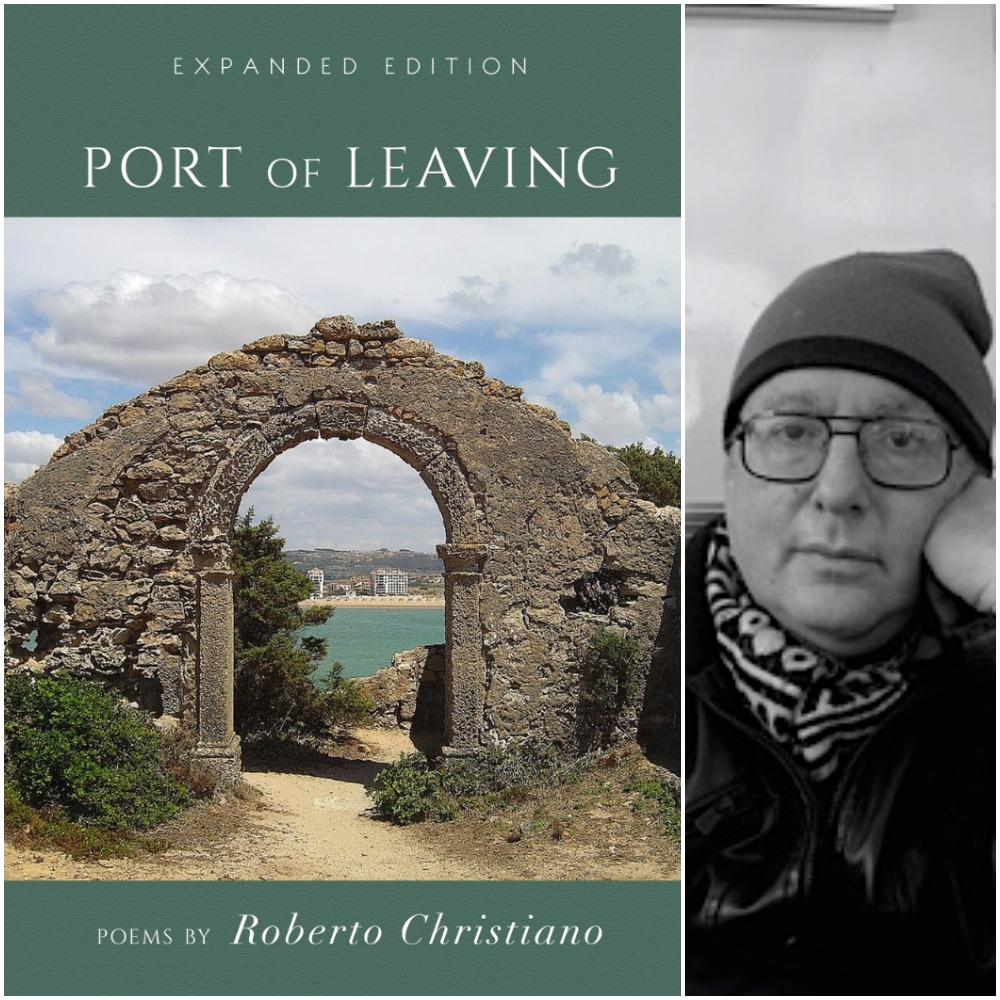
Port of Leaving, a collection of poetry from Finishing Line Press, by Roberto Christiano is a journey into the suffering inherent within the human condition. The origin of this poet’s suffering emanates ancestrally and psychically from the Portuguese port of departure (leaving) Salir do Porto and includes the hard-to-define Portuguese word saudade. Saudade infuses into suffering a longing for something that may never be achieved.


Christiano’s yearning (saudade) initially springs from the love and acceptance he wanted from his Portuguese father, a man who was a bricklayer.


Driving through Georgetown
on a congested Friday afternoon,
I find myself stopped
behind a truckload of bricks
when my father comes to me—
red brown in his Portuguese skin.
“I’m a bricklayer by trade,”
he often says,
and his hands show it—
all calloused like tree bark.

excerpt from “My Father Is a Bricklayer”

Despite his father not speaking English well and disapproving of the poet’s choice of a career in acting, this man would attend his son’s performances.


Although my father never approved of acting,

he came to see every play I was in.
His favorites were A Midsummer Night’s Dream

and Macbeth. …


My father’s choices bewildered me—

he spoke a broken English at best,

and the only thing he read
was the front page of the paper.


excerpt from “My Father and Shakespeare at the Sylvan Amphitheater”


 As a child, the poet was not allowed by his father to speak during dinner, so he tested his father (who loved to play the accordion) by singing.


I was not permitted a word at dinner

because you were too hot from laying

brick in the sun to bear the voices
of children …

Sometimes I ventured a phrase,

but you pushed me down quick.
“You no speak. You have no responsibility.”

The r in responsibility you would hit
with a rough Portuguese trill.

I watched how playing your accordion

for hours into the night soothed you.

Above the keys in gleaming silver

cursive was written Excelsior.

Since the accordion weighed too much

to pick up, I began to sing—
often in the middle of dinner.


excerpt from “Why I Sang at Dinner”


The poet suggests by noting the word Excelsior that the accordion had a higher purpose. His father neither stopped his son from singing nor showed approval.


In the wake of the father’s inability to verbally express the love and acceptance his son wanted, Christiano’s narrative, free verse or prose poems are often emotionally flat, but not so in his title poem “Salir do Porto” which ends with these lines:


I will not find the words to say to you—

little leaving port of Portugal
to whom I am forever returning.

What words could ever say
how he left me who cannot swim,

standing on your shore of sorrow?


Truth-telling and clarity comes across with this writing style of emotional flatness which invites the reader to reflect deeply on what the poet has presented. For example, in “Flight,”  we learn about the painstaking efforts the father makes to save a baby bird.


A baby blackbird
falls from a nest.
He struggles
to fly and fails.
My father picks him up,

sticks him in a cage,
puts him in the basement.

The blackbird refuses

the worms I offer him,
the same with flax seeds.

Father mashes leftover bread,

takes the blackbird
in his bricklayer hands,
feeds him mouth to beak.


The son tries to feed the bird but fails. The father succeeds and releases the blackbird into the “cold, crisp air” and the bird opens his wings and flies. The emotion that the narrator (son) feels (What if he can’t fly?—because he is the empathic one) is down played. The mood shifts to neutral because nature takes over—the father releases the bird. There is no drama. The son’s angst is down played and so there is, in this reviewer’s opinion, an emotional flatness providing clarity in just stating what happened. This writing approach makes room for seeing the quiet goodness and parental leadership of the father.


“He will fly,”

Father says,

pushing open the screen door,

advancing into the backyard.


With both hands,
he throws the blackbird

into the cold, crisp air


Sections 2 and 3 of Port of Leaving open outward to Relatives and Portugal and the World. However, the poet’s father is present in these two sections of the book as well. For example, in “Coke Memories”, the featured relative is the poet’s Great Aunt Anna who “remembers when the real thing/ first came out” and how Coke made one feel good. After all the poet writes:


In 1886, Coke first appeared
as a patented medicine—
a digestive and headache remedy

as well as an impotence aid.

Each glass contained nine

milligrams of cocaine.


The poem ends with the poet’s father thinking Coke would cure his acne:

He pedaled barefoot
on a bicycle
through miles and miles

of poverty and sorrow

to buy a Coke

because he believed

it would cure him.


The last section of the book reveals a family secret—the poet’s family had Jews who converted to Catholicism. Several times the poet asks his father what happened to the Jews? (First in section 1 “Hitler’s Trains” and later Section 3 “The Past Is Never Dead.” The poet provides the explanation in “The Wars of Rosemary and Marjoram”:


My father’s town was founded by two families—the Cristãos and the Alecrims.

The two families intermarried. My grandparents were first cousins.
We all turned out inbred, depressed, and nearsighted.


In 1497, Manoel the First of Portugal demanded that all Jews convert or leave.

Some left. Some converted. Some pretended. Some changed their names
to the names of herbs. They were called the New Christians or Conversos—

the converted ones.


Somewhere along the line in America, Cristão proved too challenging

and turned into Christiano. I came to hate it. I always thought Christiano

sounded like a stage name. And then there was history—
the history of Christianity to salt the wound.


In the rollicking 1730’s, the toast of the Lisbon theatre
was Antonio José da Silva. He wrote delicious skits with songs
satirizing politics and the bourgeoisie. Most of his plays were for puppets.

His big hit was The Wars of Rosemary and Marjoram.
The King just adored him. His nickname was The Jew.


Every Thanksgiving my favorite cousin, Elizabet Alecrim, tells me all the dirt,


I invite Cousin Elizabet to sit in the seat of honor. I begin to carve

the clove studded ham. She pours herself some wine and says,

“Have I told you yet that we have Jewish blood in the family?
After all these years, I did the Ancestry thing, and well, now I know

why Alecrim means rosemary.”


Port of Leaving by Roberto Christiano is a compelling journey of self-examination that opens out to the world we live in. It is a song in the fado tradition—“Blues of Longing”. It’s a tradition that Christiano willingly shares:


What I sang was sadness.
It was not my sadness.

It was ours.


excerpt from “Memoir”


Tuesday, October 12, 2021

At the Folger—Diane Seuss & frank:sonnets


 Diane Seuss and t’ai freedom ford opened the 53rd O.B. Hardison Poetry Series at the Folger Shakespeare


Library on October 5, 2021, via Zoom. The Dresser who recently became familiar with Seuss through her publication of a poem entitled “Gertrude Stein” (The New Yorker, August 9, 2021) attended to get a deeper understanding of Seuss who blends high and low culture in surprising ways. Teri Cross Davis as coordinator of the Folger poetry programs made a complementary match in putting these two poets together to read from work addressing voices full of the blues, loaded with down and out problems of life.


What caught the Dresser’s ear from Ford’s strong reading was: “all my poems have bullets in them.” What stuck with the Dresser from Seuss’ reading was, “The sonnet teaches you, like poverty, what you can do without.” This prompted the Dresser to order Seuss’ new book frank:sonnets, even before the program ended.


So, what does the title mean? Given that frank is lowercase, these sonnets by Diane Seuss are meant to be open, forthright, honest. The cover shows a man naked from the waist up making an odd gesture with his upraised arm—his fist enclosing his thumb. Who is this man, surely not Frank O’Hara whose poetry was open to everything and who Seuss seems to be emulating in this book of 128 sonnets? No poverty being taught in this proliferation, it’s more like obsession. Seuss said after the reading that she is still struggling to move on from the sonnet even as she is going through the divorce. However, this is the story of her life and sometimes in more detail than is necessary.


Hearing Seuss’ sonnets made the Dresser want to see how the poet put words on the page. These are not the traditional sonnets with a prescribed rhyme scheme. In untitled poems, Seuss writes fourteen lines in one stanza. Occasionally rhyme occurs. In two instances the fourteen lines span two pages such that we get a folded page in the book.


Seuss opened the Folger reading with the second sonnet of frank:


The problem with sweetness is death. The problem
with everything is death. There really is no other problem
if you factor everything down, which I was no good at
when studying fractions. They were always using pie
as their example. Rather than thinking about factoring
things down I wondered what kind of pie. And here
I am, broke, barely able to count to fourteen. When
people talk about math they say you’ll need it to balance
your checkbook. What is a checkbook and what,
indeed, is balance? Speaking of sweetness, for a time
I worked in a fudge shop on an island. After a week
the smell of sweetness made me heave, not to mention
the smell of horses; it was an island without cars,
shit everywhere. When I quit, the owner slapped me.


Death, suicide, illness, drug addiction looms large in this collection and eventually explains that the man on the cover was Mikel Lindzy, a gay man who provided the poet with much needed emotional support and who died of A.I.D.S.


The last poem in the book links Frank O’Hara and Mikel Lindzy to Seuss’ poetic strategy which is that the counter chit to death is love, however fraught. But also, Seuss cements her approach to dumping everything about life—her life and the lives of those around her—by the appearance of O’Hara at the moment of his accidental death.  Except that she only refers to him as Frank. If you are a casual reader, you might not know this Frank who got killed accidently on a Fire Island beach.


I hope when it happens I have time to say oh so this is how it is happening
unlike Frank hit by a jeep on Fire Island but not like dad who knew too
long six goddamn years in a young man’s life so long it made a sweet guy sarcastic
I want enough time to say oh so this is how I’ll go and smirk at that last rhyme
I rhymed at times because I wanted to make something pretty especially for Mikel
who liked pretty things soft and small things who cried into a white towel when I hurt
myself when it happens I don’t want to be afraid I want to be curious was Mikel curious
I’m afraid by then he was only sad he had no money left was living on green oranges
had kissed all his friends goodbye I kissed lips that kissed Frank’s lips though not
for me a willing kiss I willingly kissed lips that kissed Howard’s deathbed lips
I happily kissed lips that kissed lips that kissed Basquiat’s lips I know a man who said
he kissed lips that kissed lips that kissed lips that kissed lips that kissed Whitman’s
lips who will say of me I kissed her who will say of me I kissed someone who kissed
her or I kissed someone who kissed someone who kissed someone who kissed her.


Now, this melding of blues culture and academic/literary life—low versus high culture is what piqued the Dresser’s curiosity about Diane Suess. What the frank sonnets reveal is Diane Seuss, a poet who came up in poverty with a dying father and a neglectful mother who was studying James Joyce.


In sonnet 24,  “My first crush was Wild Bill Hickok,” Seuss reveals her mother:


…My mother didn’t care if I rescued or killed or swung from a noose until I was dead. That

was my domain. Her domain was TV dinners and James Joyce. …


The poem proceeds to its finish by saying Mikel’s first crush was a well-hung TV cowboy who died by hanging but Seuss decides:


                                                                                              …my kind of cowboy would read

tall tales from a tall book called Tall Tales about tornadoes and card games and white whales.


Seuss drops in names, often first names only, as if the reader should know who they are or at least accept that Seuss’ people are present and if you stick around, you will get more information about them, or not. Is it worth reading frank:sonnets, yes, but you, Dear Reader, are on your own to endure the smear of Little Debbie cake filling on the furniture, the inbred farm animals that were born randomly as Seuss’ mother tried to provide for her children after their father died, and every other gross experience that an unprotected child, youth, and young adult could suffer.


                                    …Did you know the dead

can fall in love better than the living cuz nothing

left to lose. The root of all blues.   

—Diane Seuss, from sonnet 4, frank:sonnets


The next literature program from the Folger Shakespeare Library is Ann Patchett (author of Bel Canto) delivering the Eudora Welty Lecture on October 14, 2021.