Showing posts with label The Word Works. Show all posts

Saturday, November 1, 2025

All Were Limones: a Reckoning of What Is

Title: All Were Limones

Author: Luisa Caycedo-Kimura

Publisher: The Word Works


Copyright:  2025

Number of Pages: 74

Special Honor: winner, The Hilary Tham Capital Collection

Blurbs by: Jennifer Franklin, Jennifer Oakes, Robert Pinsky, Dean Radner

Key Descriptors: Latin American culture, multicultural family, nature, celebration, loss

First Sentence: “If I’m a tree planted by streams/why is my tongue dry  my roots//unquenched”

Last Sentence: “Last night, I almost held berries/ for it in my hands.”

Comment: Life reveals itself in all its harshness and simple pleasures. Nothing is guaranteed but unexpected delights happen. For example, “Fireflies pan the garden nightly in search of you.”

Friday, November 19, 2021

Breaking and Entering: A Powerhouse of Poetry


The idea of position is key to reading Barbara Goldberg’s masterful Breaking & Entering: New and Selected Poems from The Word Works. Among the selections of new and previously published work, Goldberg uses position to show us place, placement, and power.


In “Furlough,” the opening poem, we see a father, possibly a soldier given his “tall, lean, muscular” stature, tossing his children in the air. The narrator says, “I love/ to see them drop, not weightless, but light// as grenades.” It’s chilling that “fear can be fun” and how the dad handles his kids is a kind of “hand to hand combat.” The Dresser is more than alarmed—where is the location of this poem? We know by the word dunam as in “That a dunam// of earth is worth dying for?” Only in Israel is land measured in this way—a dunam is equal to one thousand square meters. And thereby we understand that this man is on temporary hiatus (furlough) from his military duties and is now attending to his family responsibilities.


In Goldberg’s first book Berta Broadfoot and Pepin the Short: A Merovingian Romance, a working-class girl Aliste replaces Berta, a king’s royal bride. Aliste’s mother Margiste, a “trusted handmaiden to Queen Blancheflor,” Berta’s mother, has been entrusted to deliver Berta to her bridegroom. Except Margiste wants more for her daughter who is also Berta’s half-sister. In “Aliste Considers Her Position,” placement is seriously contemplated, but Aliste feels powerless.


Who was there to turn to when I found

his morning gift, a handsome brooch

encrusted with pearls, on my pillow?

…


Not Mother, hopping about with glee, fingers

greasy from palace meat. She pokes my ribs

and cackles, “We fooled him, eh? We two

make quite a team.”

…                                                           while I,

dumb sheep, play the part of Queen.

…                     I’ve thought of claiming

defect of consent, diriment impediment, but

Mother would be lost for good, poor sheep.


In subsequent books by Goldberg—Cautionary Tales, Marvelous Pursuits, The Royal Baker’s Daughter, and Kingdom of Speculation—the pursuit of power looms large with an ample

 dash of deception.


Consider in “The Future Has Already Happened” (from Cautionary Tales) how a little girl known as Red Riding Hood has not only triumphed over the wolf but sees this as the future with the woodcutter for her own progeny.


…Imagine the wild Caesarean,

the ax and its fresh cut, the blade

running deep. And me springing out

to dance on the planked floor with Granny

…


Give serious attention to “Ballad of the Id” (from Marvelous Pursuits) an internal powerhouse that seems inescapable.


I am your rose hips and bunting and bootleg

and I am your black bangs those devil’s

spikes

… without me you’re puny and

pallid and prudish …

I bit your sister and squealed on the porter

and who pulled you out of the muck of intention

    …who stole your tom-tom

just ask and I’ll tell you I did I did


Evaluate Goldberg’s duplicity carefully when you read “Fairytale” (from The Royal Baker’s Daughter).


Once upon a time

a baby boy was born

to a suicidal woman

and a suicidal man.


He was not born to make her sane

nor to help the marriage last

but because his birth would save

his daddy from the draft.


…


The little boy is now a man

and takes himself a wife.

One hand gently strokes her hair,

the other strokes his knife.


The knife represents power, but might the knife be a stand-in for his penis? Certainly, sex can be another tool of power.


 The final set of selections from Kingdom of Speculation take romances, fairytales, cautionary tales, and psychological treatises to a heightened level of power. Could these poems be stories of Balkis—Queen of Sheba or the woman Hatshepsut who became the Pharaoh Hatshepsu (a woman pharoah who presented herself as a man)? In “The Master of Chance,”  we meet “The Princess looking no more/ like a Princess than you or I” who dwells in “the Province of Chance.” It’s an odd exchange between a shabby royal and a card-playing man calling himself the Master of Chance. He wants her to marry him so she can polish his casket of gold which she recognizes as one that had belonged to her father. The poem ends with the man asserting his power:


A woman in my employ, as is everyone

 in this State, for I’m the Master


 of Chance, I cut the deck, declare

what’s wild, as you are my dear, my Balkis,

my Hatshepsut, my true Queen of Hearts.


“A Great Darkness Falls,“ the last poem of Breaking & Entering we recognize the shabby princess who now has possession of the King’s coffer which she uses as “a fertile bed/ for her cuttings and seeds” while incubating in her purse the “Egg of perfection.”


… All is poised for

an ever after. Sing praise to the Great

Lord Chaos, his enabling dark. Praise


to the touch of a choice companion.

And praise to the Egg of Perfection

glowing in the folds of a lady’s purse. 


These lines close the book on all Goldberg’s books in that wish for a fairytale ending that provides love, union, and progeny, while placing the power in the female grip.                     



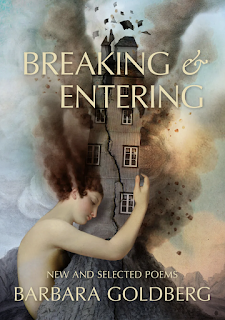
The book’s title Breaking & Entering comes from the poem “Alarums and Excursions” (from Marvelous Pursuits). The poem deals with a modern-day woman who interacts with a security professional, “a man who knows the tricks of breaking/ and entering and how to secure all she holds/ dear from those who would trespass against her.” The cover image, a digital artwork entitled “Tower” by Catrin Welz-Stein shows a youthful nude maiden (a figure like those in Renaissance paintings by Titian) embracing the bottom of a tall building built possibly on a volcano and which is breaking apart and on fire. The nude’s long hair is swept up in the wind of the explosion. The image speaks ably to the explosive emotional content of Goldberg’s book which presciently summons our current day turmoil that deals with place, placement, and power as well as truth and lies.


Monday, May 10, 2021

A Tour to the Heart of Skirted


Consider this review of Skirted by Julie Marie Wade not so much critique but map. The Dresser suggests this route in: understand that the journey deals with self-discovery, especially sexuality and independence. How does a grown child detach from the mother and escape from a script written without regard for the maturing offspring?


Map suggests itself because each of the five sections of this book begins with a poem entitled "Pangaea." Pangaea refers to the supercontinent comprised of all our earthy continents fitted together like a jigsaw puzzle. “These continents—/land    or    sleep    or    snow/(things that drift, that deepen)//And the nets of the heart cast wide across the ever-widening sea//(Ts’ai Ken T’an)   Water which is too pure has no fish.//…//For my mother, one indisputable truth—/how men & women are meant to cleave:/the sheaves of their bodies bundled//weltered re-enactment of Adam & Eve…”


While, the reference in transliterated Mandarin Ts’ai Ken T’an can mean in English “water which is too pure has no fish,” the essence points to a reality check that the purity of childhood has been superseded in the adult by the grime of living. Wade wastes no time or paper with end notes. She packs in philosophical ideas of consequence throughout this poetic treatise that relates a story of sexual awakening.


She tried to comply with her mother’s wish that she make a traditional marriage. “…I wanted to be just like all the others. I knew I could love a man. I was well-practiced in the art of obligation & I had a curtsy or two left in me from the formative ballet class.” However, she had a dream that she “turned suddenly male” and decided, “I wouldn’t let the world crack open: Twilight Zone or worse Twilight of the Golds.” The Dresser, of course, thought Twilight of the Gods, the Wagner opera where the superhero that our pop culture calls the Fat Lady was being referenced and our poet in Skirted was dealing with a trial by fire just as Brunhilde had been subjected to by her father. No. The Dresser pulled up short and regrouped because Julie Marie Wade is a careful writer. Sure enough, an Internet search quickly revealed Twilight of the Golds is an American film (screened at Sundance in 1997) where parents consider aborting their baby because its genes test positive for gayness. By the end of the prose poem “You can’t marry someone when you’re in love with someone else.”, the poet’s movie of Truth has evolved to The Sound of Music but some of the gender roles have reversed. “…I was no Captain Von Trapp, & my husband-to-be no Baroness Schraeder.” What’s funny is the woman the poet loves not only doesn’t resemble Von Trapp’s Maria but also has never seen this exuberant musical. So, one person’s truth is not another’s—if that person even gets what that truth is.


For the Dresser, the pièce de résistance is “Love Poem for Sisyphus.” Written in couplets with an epigraph by Albert Camus—“To the celestial thunderbolt he preferred the benediction of water.”—building a love relationship is hard work with a lot of backsliding. The poem has that T.S. Eliot weariness and contradiction.


As do I, so often: soothing flux of these currents,

soft baptism of this rain; never the sense to come in


out of, now the certainty that life remains

uncertain: the pleasure this brings us, the pain.


O Sisyphus, how you surprise me, man after my own heart:

absurdist hero, friends sought for strength in futile struggle.


Sometimes we cherish in others what we cannot embrace

in ourselves; all this standing water in the well


of consciousness, raising my pail only to pour out

its contents again: how to distinguish—


repetition from redundancy?

anaphora from tautology?


…


In Western literature, fire metaphors (like thunderbolts) typically point to males and water imagery to females. In lesbian literature (such as Tender Buttons by Gertrude Stein), water often takes on male resonance. Here that  “well of consciousness” makes the Dresser think of Hemingway complaining that if you go to your well (source of your creativity) too often, the unconscious mind will be depleted. Wade’s well seems to be feminine awareness that has overtaken (flooded, ergo standing water) her consciousness. Then Wade’s question is how to navigate between repetition (anaphora) which can be good in its comforting musicality versus redundancy (tautology) which repeats stupidly (like the vulgar word irregardless).


An outstanding example of anaphora is “’I’m drowning here, & you’re describing the water.’” First, note that Wade is quoting the character Melvin Udall (played by Jack Nicholson) in the film As Good as It Gets when he reaches out to a friend for advice on the occasion of his lover rejecting him. In Wade’s anaphora, every sentence of this prose poem begins “The water.” It seems the water is Wade’s mother, the one that “remembers when you were a child…keeps your pink jelly-shoes for posterity.”


Skirted is a masterful literary work with vital psychological portraits. Wade is deft at mixing high and low elements of Western life in the tradition of postmodernism. She exercises word agility that signals meta poetics but is clearly essential in communicating the distress experienced in breaking with her past and forging a new life.


“You once understood unanimity. Now you know best anonymity. Amity & enmity have been reversed in places. The ones you loved best know the least about you. …” from “Reading Robinson Crusoe Again, for the Last Time.”


One final thought about the title of the book—in “Skirt the issue.”, a prose poem where the word skirt is used many times but the poem does not take shape as anaphora but rather as a cautionary tale, well, maybe also as the dread tautology:


"…& most important of all bed skirts which disguise not only the sin of the skin but the place where flesh is most likely to mingle no shortage of skirts & nothing that can’t be covered by a simple drape & a few stitches of pliable silk you think you won’t be skirted just you wait"


In other words, the poet is saying to be skirted is to be put in your place. Here the tour ends, but the Dresser recommends this is only the beginning of sights and insights.