Thursday, June 29, 2023

Meet Gary Stein, Poet Raconteur


Gary Stein has a new poetry collection in 2023 from Finishing Line Press entitled Getting to Heaven [And Other Miracles]. This chapbook presents beautifully with cover art by Susan Makov and contains many accomplished poems published in such prestigious journals as Commonweal, The Atlantic Review, and JAMA (Journal of the American Medical Association). The Dresser has been following his publishing accomplishments since 2003 when Cabin Fever, The Word Works anthology he co-edited with Jacklyn Potter and Duane Rieves was launched. The Dresser offers the following interview in attempt to expand Gary Stein’s audience.


1.     Your background: Tell us about your literary background and philosophy of writing.

Answer:

 I was an avid reader as a child and got encouragement for my stories from a sixth-grade teacher.  In college I took elective courses in satire and playwriting.  A one-act play I wrote in the 60’s was performed and positively reviewed in The Washington Post (under the name “Gary Allen”). I was admitted to the Iowa Writers’ Workshop for fiction writing based on a trio of short stories I submitted.  While there I worked on a novel and lived with poets who became quite successful. We read and heard lots of poetry and hung out with poets including Galway Kinnell and Richard Hugo. Following Iowa, I managed to publish a couple of short stories, failed to publish my novel, but began writing poems. After a couple of years, journals began publishing some of my poems. 


2.      What does writing do for you? What motivates you to write? Why is poetry the genre of choice for you?

Answer:

I’m embarrassed to say that I’m not aware I have a “philosophy of writing” other than writing to entertain and/or enlighten myself.  Perhaps I’ve chosen poetry as a genre because I enjoy creating condensed images. While practicing law for many years, it was easier to complete a poem than a lengthy work of fiction.


3.     Talk about your book and chapbook achievements and where your latest chapbook Getting to Heaven fits into your overall plan for yourself.

Answer:

   Thanks to Poets and Writers and “Duotrope”  I’ve been fortunate in learning of and entering competitions permitting me to win first prize for Touring the Shadow Factory, a full-length collection (Brick Road Poetry Press, 2019), and be named a chapbook finalist for Between Worlds (Finishing Line Press, 2014). Earlier this year Finishing Line Press also published my second chapbook, Getting To Heaven (And Other Miracles) which contains some of my older but hopefully more amusing poems.  My “overall plan” is to keep writing poems as long as what I’m capable of producing does not embarrass me.


4.     If you could only pick one poem from Getting to Heaven to read, which would it be?

Answer:

   Good question.  I might pick the opening poem, “A Bough Falls” because like so many of my poems it tells a story concisely, portrays my Catholic background, and uses imagery I like to think is successful.  If I had a second choice, it would be “Why My Wife Should Let Me Have A Dog” because I think it’s funny.


5.     In Getting to Heaven, who are your influences, and could you talk about your process, possibly in conjunction with the one poem you would favor in the case of being asked to pick only one poem from this collection.

Answer:

    Although I’ve identified as a Quaker for over 35 years, based on the subject matter and book title, my Catholic childhood and education (from grammar school through college) are strong influences on my subject matter.  Also, having a sense of humor, even about important subjects like religion and spirituality, are reflected in many of these poems. Finally, my life-long love of narrative fiction is reflected in poems that frequently begin with a story. Good examples from the new chapbook include “Crossing El Rio San Pedro, Puebla, Mexico,” “A Bough Falls,” and “Note To My Father As I Near The Age Of His Death.”  My process often begins with a specific event or experience from which I keep writing until I discover its deeper meaning.


To complete the picture of Gary Stein, the Dresser ends with “A Bough Falls.”


A BOUGH FALLS


Cut loose, betrayed by air it lands

like a lost gift on silent

indifferent earth until found


by a man of faith in an afterlife,

perhaps a priest in his black cassock

who later in a lonely rectory marries


imperfect oak to bundled kindling.

His match, a splinter of grace,

sparks petals of persistent light


into bloom and spreads healing

heat while wood whispers

like an angel in the quiet night.


Isn’t fire just another prayer offered

to cure the darkness in time? 

But every clock winds down


and wood turns to ash, and air

in the chimney chokes

on its smoke. The priest believes


that only when a soul is freed

from its body, like vapor

from the charred log, will it rise.


—Gary Stein

    (first published in Commonweal, May 2022)


Thursday, May 18, 2023

Spoken Word Club Features Poet Barbara Goldberg


If the Dresser were allowed only five words to enter the poetry of Barbara Goldberg, the Dresser would choose danger, death, sex, psyche, and fairytale.


Take “Furlough,” the first poem in Goldberg’s Breaking & Entering: New and Selected Poems where the first line begins with sexual attraction:


I love to see those tall, lean, muscular men


The next several lines depict danger, possibly verging on death


I love to see those tall, lean, muscular men

with their clean-shaven heads and digital


watches toss their kids in the air. And I love

to see them drop, not weightless, but light


as grenades.


As we learn more about this type of man, we see his soldierly discipline, the mind controlling his behavior, his bodily actions, the essence of his psyche, and we enter a story landscape, possibly an untold fairytale for those children tossed so casually in air.


as grenades. This how children learn that fear

can be fun. And fathers, that this too is hand


to hand combat. To cradle or kill—what story

do we tell ourselves to justify. …


Six sections of Breaking & Entering provide heart-stopping imagery and lyrical allure. Finish reading “Furlough” in the New section.


Not to be missed in section II—Berta Broadfoot and Pepin the Short is “Aliste Speaks with Double Tongue.” In this poetic story about a nursemaid who substitutes her daughter Aliste for the royal girl Berta set to marry King Pepin, Goldberg offers a poem written in two columns that can be read as two columns or line by line across the two columns. Here are the first three lines:


                               I couldn’t stand    this fact: they were torturing her

                                     I couldn’t sit   I could hear her shrieks

                       I paced, a wild thing    She couldn’t save me now


Section III Cautionary Tales recounts Goldberg’s versions of Little Red Riding Hood. The Dresser is loath to pick just one poem when there is “Teeth”—We all live in dread of our teeth…; “Née Maggie Malone”—She didn’t shave her legs or underarms…(winner of the first Word Works Washington Prize) and “Night at the Opera”—Although Aida and Rhadames are buried alive/in a crypt…(as told by the eight-year-old author) and much more.


Without a doubt, Section IV Marvelous Pursuits demands that an out loud reading of “Ballad of the Id” which begins I am your rose hips and bunting and bootleg.


In section V The Royal Baker’s Daughter, the Dresser favors the three-part poem “My Father’s Mistress”—She of No Name who wore sensible shoes unlike the narrator’s mother, Herta who lived in a rustic chalet, or Lily who was a Marlene Dietrich look alike.


The title poem by the same name of section VI The Kingdom of Speculation is certainly the Dresser’s favorite where


Eggs coddled or poached are the food

of choice in the Kingdom of Speculation


this is where the rich eat eggs and the poor, heavy-in-the-stomach dumplings.


Why not request one of these poems when Barbara Goldberg is featured in a virtual reading on May 23, 2023, at 4 pm Eastern from Spoken Word Club. Bring a poem of your own for the open mic. Here’s the link: https://www.facebook.com/events/1433183454098878/?acontext={"ref":"52","action_history":"[{\"surface\":\"share_link\",\"mechanism\":\"share_link\",\"extra_data\":{\"invite_link_id\":792016829159657}}]”}


Sunday, April 30, 2023

The Excellence of the 21st Century Consort


21st Century Consort on April 29, 2023, presented “Echoes of Earth Day,” the last program of this season to a full house at Washington, DC’s St. Mark’s Episcopal Church in its glorious sanctuary with many colorfully grand stain glass windows. The Dresser goes on the record to assert this was an outstanding concert with excellent performances by accomplished musicians and a superb program selected by Artistic Director Christopher Kendall. Central to all the works is an expanded timbral palette.


A last-minute change of composition order featured first  Wang Jie’s “Sonata for the Other Shore” as played passionately by pianist Lisa Emenheiser. This was the American premiere. No doubt that composer Wang Jie who was present found Emenheiser’s performance of this difficult and theatrical composition meeting her expectations.


No less challenging was Juri Seo’s (also present for this concert) “Suite” played masterfully on the cello by Rachel Young. “Suite” in five movements was inspired by and subtly reminiscent of the unaccompanied cello suites of J. S. Bach. The work featured a scordatura tuning of the lowest string and extensive use of harmonics on all the strings.


Absolutely the Dresser’s favorite selection justly positioned to close the first half of the concert was “Whispers” by Sebastian Currier. In this work, percussion executed with dazzling precision by Lee Hinkle accented the equally precise performances of Lisa Emenheiser on piano (using the keys and internal strings of her instrument), Rachel Young on cello, and Sarah Frisof on flute. Not a minute went by without Hinkle’s subtle touch on snare drums, vibraphone, tambourine, and woodblocks.


“Danza de la Mariposa” by Valerie Coleman opened the second half of the program. This delicate and energic tone poem featured flautist Sarah Frisof.


George Crumb’s classic ecologically-themed work “Voix Balaenae” (Voice of the Whale) opens with a recording of whale calls and then moves into response first from flautist Sarah Frisof and then more formally in the segment known as “Sea-theme” by cellist Rachel Young and pianist Lisa Emenheiser. One unusual feature of this work is that the flautist and cellist alternately play antique cymbals. It was certainly this edgy piece by Crumb that motivated the Dresser to go out for this concert and it did not disappoint.


21st Century Consort is an exceptionally notable group of musicians giving voice to contemporary classical music and deserves every bit of publicity it can garner. Washington DC is blessed to have such talent.


Tuesday, April 11, 2023

Playing in The Court of No Record


The Dresser has noticed a swell of poetry collections written in the sway of lawyerly or criminal justice language dealing with misogynistic violence. Some of the books the Dresser has seen are Annie Kim’s Eros, Unbroken (winner of the 2019 Word Works Washington Prize), Susana Case’s The Damage Done (2022: Broadstone Books), various books by Monica Youn (e.g., From From 2023: Graywolf Press) and the focus of this review Jenny Molberg’s The Court of No Record (2023: LSU Press).


Playing in Jenny Molberg’s Court of No Record is a game that is loaded against the crime victim. Operative words for Molberg’s book The Court of No Record are evidence, testimony, and investigation. No worries there is plenty of poetry and it begins right away in the prologue poem entitled poetically and optimistically “ May the Stars Guide You Safely Home.” This is a poem written in couplets and while it begins  with a frightening prosaic declaration, it moves into poetic imagery about the people of America watching a show about an allusive man whose eyes can’t be seen because his eyes are so cold they create a fog on the lenses of his glasses:


After I call the cops to ask for a protective order

I read about the girlfriend of a serial killer. What she knew,


what she didn’t. How it seems we’re always punished

for asking questions. America is watching a show


about a man who is fascinating. His eyes ice

behind the fog of his glasses.


One of the actions that follows is that the narrator describes the call to the police and uses unexpected similes to depict her state of mind:


When I call the cops

I hold my arm like a seatbelt. When I call the cops


a woman answers. Hand over chest like an elementary

school lie: the pledge, the flag, the wrong math.


The arm held like a car’s seatbelt is a protective gesture, but the hand over the chest suggests a lie. However, it is a lie that she says is taught to little children—who must pledge their allegiance to the American flag where we citizens get “liberty and justice for all.”


Other details of this poem reveal that the girlfriend of the serial killer rode in his car which, unbeknownst to her, carried the body of a woman he had killed. However, the said girlfriend had also killed someone. Furthermore, the policewoman tells the narrator that by reporting this man, she could be making the situation worse for herself and that she should get a gun and be prepared to use it. So, the narrator calls a domestic abuse hotline, and they say her abuser has beat her to that hotline first and they can’t talk to her.


This is the stuff of nightmares, and the reader might question if the narrator is locked into disturbing dreams and therefore not telling things as they are:


The night of the hearing I awake thinking

I am the girlfriend, the silence of the trunk


an ocean. It takes hours to rise, to gather myself,

part by part, pulling the truth from the dark.


This is my face. This is my name.

Someone loves me.


My voice is animal in the courtroom microphone.

Behind the judge, the sideways prison of the flag.


Well, yes, she is living a disturbing dream and mixing up information because she is so upset and not getting any help from the justice system. Notice the metaphor that her voice is animal as she tries to give her testimony.


Molberg’s book is divided into three sections. Section I “Expecting” sets up the crime scenes and includes poems drawn from the dioramas of Frances Glessner Lee. The emphasis is on evidence.


Section II “The Court of No Record” is a long poem that deals with testimony in the courtroom. The poetic landscape often alternates between prose poems and a five-line haiku. Metapoesis plays a strong role as the poetry of the narrator becomes an issue in the courtroom. For example, the haiku “Evidence: She Said” is paired with the prose poem “My Testimony.”


Evidence: She Said


The cops?

When he chased me

down an alley, they stood

blue, unmoved. He can spin a badge.

Turn them.


In “My Testimony,” the narrator takes the stand and is badgered by the Alpha who is suing the narrator. However, everyone else—the Alpha’s lawyer and the judge—harass the narrator also. The judge says, “I don’t need to know whether these things happened to her, only if she wrote about them.”


Section III “What Love Does” focuses on a recurring character called “Bitch.” This is Molberg’s investigation of women. The bottom line is that women must become strong like the Bitch in “Bitch Monitoring Your Phone”: “I am a citizen detective. I am a sleuth.”


What Jenny Molberg and other women like Annie Kim, Susana Case and Monica Yuan are doing with their books of poetry is providing witness and testimony to injustices against women and those who are weaker than prevailing authorities. This is not beautiful poetry. This is poetry seeking  awareness and change.


 Photo by Johnny Ulasien

Tuesday, March 21, 2023

Blown Away by Blue


If there is only one opera that an American citizen could ever see, the Dresser believes fervently that opera, a story about race in America, should be Blue with music by Jeanine Tesori  and words by Tazewell Thompson. This is the opera snatched from the Dresser and the Washington DC community and beyond in March 2020 when Covid closed down the Kennedy Center. At long last, the Dresser saw the Washington National Opera (WNO) production on March 19, 2023.


Since its premiere July 14, 2019, during the Glimmerglass Festival, many young black men or boys have lost their lives in the hands of white police officers. Tazewell’s poignant libretto begins with a teenage Black boy who becomes a policeman. He and his wife birth a son who grows up protesting police brutality. The Son is shot and killed by a White cop. Bass Kenneth Kellogg, a graduate of the Duke Ellington School of the Performing and Visual Arts who created the role of The Father at Glimmerglass and has performed it consistently in a string of Blue productions across the United States—Seattle Opera, Michigan Opera Theatre, Toledo Opera, Pittsburgh Opera. Kellogg’s performance, along with Briana Hunter’s as The Mother, stands out for  singing and acting. Hunter is the original mezzo-soprano from the Glimmerglass premiere.


Despite the tragedy of The Boy’s death, this two-hour-and-fifteen-minute work with one intermission and in two acts is well balanced with moments of levity and love. Yet the emotional balance is achieved in the face of racist clichés that label a significant percent of America’s population as “happy Negroes singing spirituals” or “niggers.” While Thompson intends for audience to view his characters as prototypes—no character has a name—their humanity is palpable and deeply moving. When The Mother tells the Girlfriends about how much she loves her husband (The Father) and that they are going to have a baby, a baby boy, they are wary about her husband being police and warn her that a son will be nothing but trouble. Still, they surround her with their loving friendship and are not a Greek chorus of doom.


Likewise, The Father’s fellow officers tease him about how he will become a warden of “baby jail.” Like the Girlfriends, the Policemen show support by letting The Father know they are envious that he will have a son.


Tesori’s music is every bit equal to Thompson’s engrossing libretto. The music is tonal, sometimes jazz inflected, and swells with Copland-like resonances. Often the music is accented with surprising percussion such as celesta and strummed piano strings.


Tesori is a well-known musical composer (e.g., Caroline, or Change, 2003) and WNO produced her children’s opera The Lion, the Unicorn, and Me in 2013. One thing that was disconcerting—Blue is being performed in the Eisenhower Theater where the orchestra pit is too small to accommodate the percussionists. The percussion section was relegated to a remote location. The size of the orchestra pit probably had some influence over WNO’s decision to make this production a chamber version.


Hats off to Tazewell Thompson who also served as the Director. Sets combined projections and furniture moved in and out by the players. The simplicity of the set and the small theater (as opposed to the Kennedy Center’s Opera house) worked very well to create an intimate theater experience. Two performances March 22 and 25 remain. The opera moves next to the English National Opera in London.


Photos by Scott Suchman

Saturday, February 25, 2023

A Debut Poetry Collection from a Master Teacher—Cathy Hailey


A lot is packed into Cathy Hailey’s Finishing Line Press chapbook I’d Rather Be a Hyacinth. All the poems are haiku sonnets. She tells us she learned about this form in The Poetry Gymnasium by Tom Hunley. With a few words to each line, she constructs Shakespearian sonnets with four haiku (most stanzas following the five-seven-five syllable count in three lines) and one rhymed couplet.


Most of the poems deal with nature, either the physical world or human nature as in behavior. There are also ekphrastic poems, the greater number of these describing dance performances. “Under the Sun,” her opening poem about a vase invokes movement and sensation in most lines, a call to find life in seemingly still manmade art.


Under the Sun (an excerpt)


Helios ascends,

bursting urns of golden fire,

glazing graceful winds.


Rhapsodizing lyre

song, strummed by Apollo’s hand,

transcends bound canvas.


…


The overall title of the collection is found in her last poem of section II.


In Life…


Hyacinths, Purple—

baby blooms adding stress, weight—

instinct maternal.


Tulips variegate

orange-yellow, dancing, coy,

above troupes of green,


singular pride, joy

even with no breeze.

In life, I’d rather


be a hyacinth,

embrace the role of mother,

live the labyrinth,


loved by a brood of florets—

barycenter of orbits.


The poet sees the hyacinth as a mother figure which transcends earthly boundaries as the “barycenter of orbits,” an outer space phenomenon where two or more bodies orbit one another. Elevation and transcendence are what the poet has her creative eye attuned to.


This brings The Dresser to the stunningly beautiful image Cathy Hailey created for the cover of I’d Rather Be a Hyacinth. The image combines a rosebud with the hint of a human profile, butterfly wings as shoulders, a lush display of purple leaves (looking like a ballet tutu), and a pair of stems that seem to represent legs and feet in ballet toe slippers.


But there is one more thing to notice and that’s the final poem and the only poem in Section III entitled “Afterword”. Hailey makes a swipe at “long-winded verse in “In Closing”. The ending couplet redeems:


In Closing (excerpts)


To curb long-winded

verse—haiku, haiku sonnet—

excess rescinded.


…


There’s magic in condensing,

precision in expressing.


Like many William Shakespeare plays, Hailey provides an epilogue to her collection of haiku sonnets. I’d Rather Be a Hyacinth is a notable first collection from a poet who is gathering her power after years of teaching others about poetry and writing.

Sunday, February 12, 2023

The Visibility of an Artist: Giuseppe De Nittis


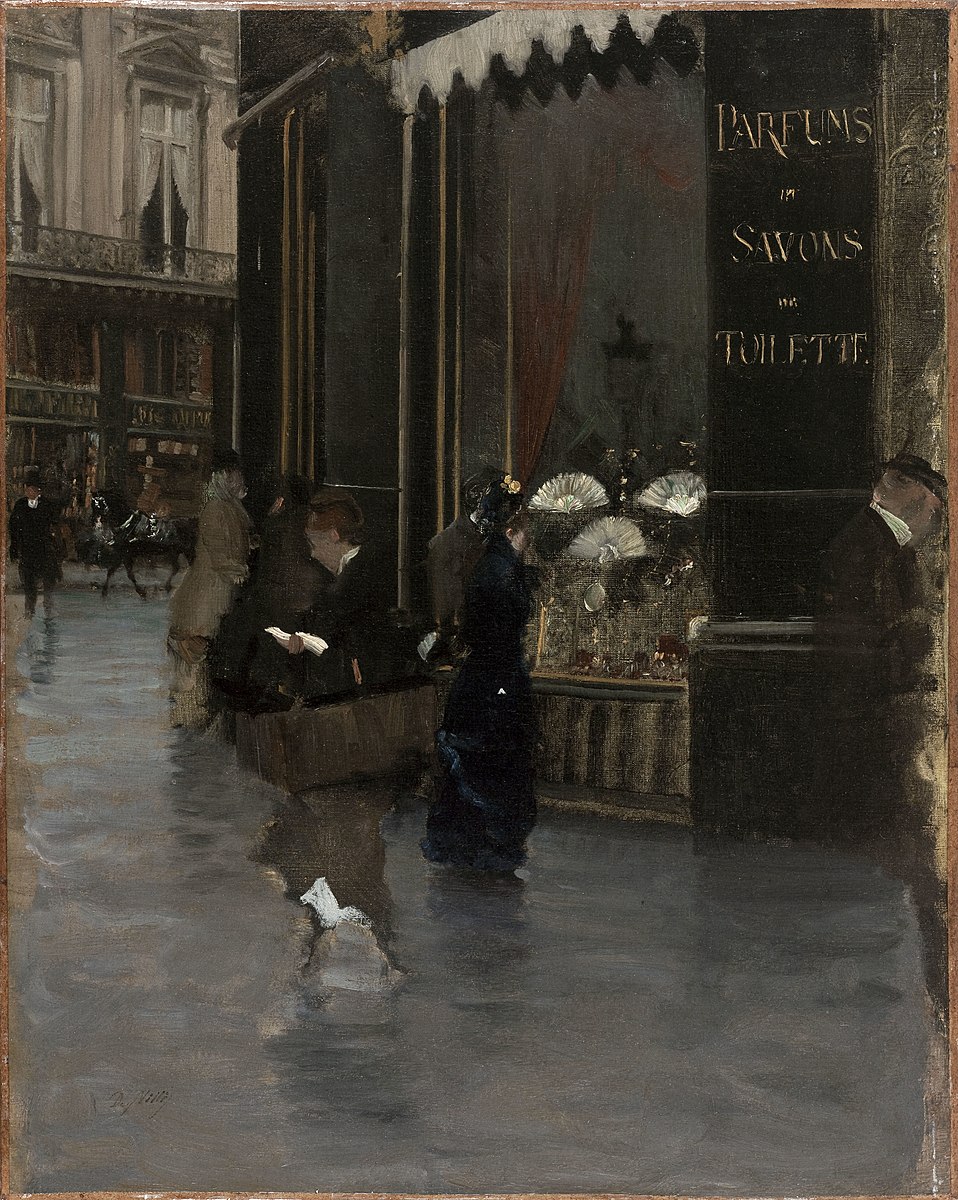
The Dresser wasn’t planning to write about “An Italian Impressionist in Paris: Giuseppe De Nittis,” the exhibition that closes today February 12, 2023, at The Phillips Collection. However, several factors congregated in the Dresser’s consciousness that needed outlet.

—Number one is that De Nittis sometimes painted in a remarkably engaging Realist style and other times he experimented such that both Realism and Impressionism show up together which seems a contradiction in styles but work fascinatingly well in his paintings. Most striking is La parfumerie Violet where the background figures and buildings appear Realist and the foreground figures are Impressionist (a man at the right side of the canvas whose lower body disappears against the building’s black backdrop and a woman carrying a basket who feet blend with the wet street). 


—Number two is that De Nittis died at age 38 from a stroke and at the rise of his career. A circulating docent at the Phillips said a possible reason he isn’t better known was because the critics were unable to pigeon-hole him while lesser-known Impressionists are much better known.

—Number three is that this exhibition of 73 works, 60 by De Nittis coming from Italy, France, and the United States is not going to be shown anywhere else after it closes.


De Nittis was friends and working colleagues with Edgar Degas, Edouard Manet, and Gustave Caillebotte. Renato Miracco, curator of the De Nittis Art Gallery in Barletta, Italy, and the guest curator of this exhibition shows the influence of these three well known painters on De Nittis. Interestingly, Caillebotte, though considered an Impressionist, painted in a style more known for its realism.


One more painting of De Nittis that the Dresser wants to note is Promenade Hivernale. In this painting, the realistically presented, beautifully dressed woman with melancholy eyes is the painter’s wife. The Impressionistic background shows a Japanese influence.


In the United States, paintings by Giuseppe De Nittis can be seen in such museums as the Metropolitan Museum of Art in New York and the Philadelphia Museum of Art. In Europe, his work can be found in Musée d”Orsay in Paris, the British Museum in London, and the Pinacoteca De Nittis in the Palace of Marra in Barietta, Italy where he was born.