Showing posts with label Tazewell Thompson. Show all posts

Tuesday, March 21, 2023

Blown Away by Blue


If there is only one opera that an American citizen could ever see, the Dresser believes fervently that opera, a story about race in America, should be Blue with music by Jeanine Tesori  and words by Tazewell Thompson. This is the opera snatched from the Dresser and the Washington DC community and beyond in March 2020 when Covid closed down the Kennedy Center. At long last, the Dresser saw the Washington National Opera (WNO) production on March 19, 2023.


Since its premiere July 14, 2019, during the Glimmerglass Festival, many young black men or boys have lost their lives in the hands of white police officers. Tazewell’s poignant libretto begins with a teenage Black boy who becomes a policeman. He and his wife birth a son who grows up protesting police brutality. The Son is shot and killed by a White cop. Bass Kenneth Kellogg, a graduate of the Duke Ellington School of the Performing and Visual Arts who created the role of The Father at Glimmerglass and has performed it consistently in a string of Blue productions across the United States—Seattle Opera, Michigan Opera Theatre, Toledo Opera, Pittsburgh Opera. Kellogg’s performance, along with Briana Hunter’s as The Mother, stands out for  singing and acting. Hunter is the original mezzo-soprano from the Glimmerglass premiere.


Despite the tragedy of The Boy’s death, this two-hour-and-fifteen-minute work with one intermission and in two acts is well balanced with moments of levity and love. Yet the emotional balance is achieved in the face of racist clichés that label a significant percent of America’s population as “happy Negroes singing spirituals” or “niggers.” While Thompson intends for audience to view his characters as prototypes—no character has a name—their humanity is palpable and deeply moving. When The Mother tells the Girlfriends about how much she loves her husband (The Father) and that they are going to have a baby, a baby boy, they are wary about her husband being police and warn her that a son will be nothing but trouble. Still, they surround her with their loving friendship and are not a Greek chorus of doom.


Likewise, The Father’s fellow officers tease him about how he will become a warden of “baby jail.” Like the Girlfriends, the Policemen show support by letting The Father know they are envious that he will have a son.


Tesori’s music is every bit equal to Thompson’s engrossing libretto. The music is tonal, sometimes jazz inflected, and swells with Copland-like resonances. Often the music is accented with surprising percussion such as celesta and strummed piano strings.


Tesori is a well-known musical composer (e.g., Caroline, or Change, 2003) and WNO produced her children’s opera The Lion, the Unicorn, and Me in 2013. One thing that was disconcerting—Blue is being performed in the Eisenhower Theater where the orchestra pit is too small to accommodate the percussionists. The percussion section was relegated to a remote location. The size of the orchestra pit probably had some influence over WNO’s decision to make this production a chamber version.


Hats off to Tazewell Thompson who also served as the Director. Sets combined projections and furniture moved in and out by the players. The simplicity of the set and the small theater (as opposed to the Kennedy Center’s Opera house) worked very well to create an intimate theater experience. Two performances March 22 and 25 remain. The opera moves next to the English National Opera in London.


Photos by Scott Suchman

Tuesday, December 7, 2021

The Seven Voices of Seven Guitars


The blues, music and grit of the life inspiring such melancholic tones, infuses August Wilson’s play Seven Guitars, especially under the direction of Tazewell Thompson at Washington, DC’s Arena Fichandler Stage. Opera aficionados may know Thompson worked as librettist with composer Jeanine Tesori on Blue which enjoyed its world premiere at Glimmerglass in November 2019. For Seven Guitars, Tazewell has enlisted sound designer Fabian Obispo who has pleasurably woven additional blues songs as introductions or interludes to the tunes written into the script by August Wilson. The Dresser saw an engaging performance of this production on December 4, 2021.


“Suffering the pain of living,” aptly sums up the Black experience of Wilson’s seven characters in a story focused on a guitarist named Floyd “Schoolboy” Barton (Roderick Lawrence) whose song “That’s All Right” unexpectedly is being played and popularized on the radio in Pittsburgh where he lives. Floyd is on his way to recognition with an invitation to record his music in Chicago. However, he has just been released from the Workhouse (jail) for vagrancy and he needs to recover his electric guitar from the pawnbroker. He tells Vera (Joy Jones), the girlfriend he jilted, that he wants her to go with him to Chicago. Meanwhile, Canewell (Michael Anthony Williams), the harmonica player in his band, has been courting Vera. The pain of living comes up in an exchange between Floyd, Canewell, and Hedley (David Emerson Toney), a patois-speaking man who says Buddy Bolden (the first jazz musician and cornetist) is going to bring him money so he (Hedley) can buy a plantation where no white man can tell him what to do.


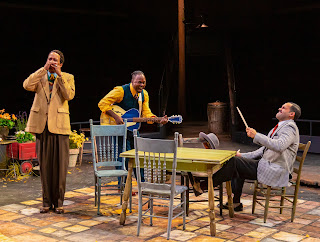
The play, part of Wilson’s ten-play series on Black life in the Twentieth Century and which premiered in 1995, continues to speak to issues of our day—Black-on-Black violence, police harassment of Black men, rural-folks-versus-city-dweller prejudice, poverty, and abusive fathers. The play opens and closes on the death of Floyd. In the first scene, we experience his funeral and, in the last, we witness how he is killed and who kills him. In between, we feel the pain and joy of these characters. A favorite scene occurs when the three members of Floyd’s band make music with an old guitar, harmonica, and drumsticks played on a table. Of particular poignancy is the comic scene that turns dark dealing with a noisy rooster, a metaphor for the Black men in this story. Canewell tells his friends that the reason the rooster crows so loud is that before the Emancipation Proclamation, roosters didn’t crow, but after [Black] “people got to whooping and hollering so” and the rooster “say, ‘Naw, you all ain’t gonna leave me out.’”


The players all meet the exigencies of their roles—Roderick Lawrence as Floyd “Schoolboy” Barton is impetuous and reckless. David Emerson Toney as Hedley is unpredictable and hard to understand. Joy Jones as Vera is naïve and doleful. Michael Anthony Williams as Canewell is sweet (like his name that refers to sugar cane) and boyish. Roz White as Louise (Vera’s roommate) is motherly and the voice of reason. Dane Figueroa Eddi as Ruby (Louise’s Alabama cousin running from a murderous and jealous boyfriend) is a hotpot of sex. Eden Marryshow as Red Carter (drummer in Floyd’s band) is a smart ass and skeptic. Sometimes, what these seven voices say plays out too fast to grasp. This is a long play clocking in at just under three hours with one intermission that requires sharp attention to fully enjoy the emotional load. This is a play you might want to see more than once.


Seven Guitars runs through December 26, 2021.


Photo of Floyd & Vera by Tony Powell.

Photo of Floyd's band by Ryan Maxwell.