Showing posts with label Barbara Goldberg. Show all posts

Thursday, May 18, 2023

Spoken Word Club Features Poet Barbara Goldberg


If the Dresser were allowed only five words to enter the poetry of Barbara Goldberg, the Dresser would choose danger, death, sex, psyche, and fairytale.


Take “Furlough,” the first poem in Goldberg’s Breaking & Entering: New and Selected Poems where the first line begins with sexual attraction:


I love to see those tall, lean, muscular men


The next several lines depict danger, possibly verging on death


I love to see those tall, lean, muscular men

with their clean-shaven heads and digital


watches toss their kids in the air. And I love

to see them drop, not weightless, but light


as grenades.


As we learn more about this type of man, we see his soldierly discipline, the mind controlling his behavior, his bodily actions, the essence of his psyche, and we enter a story landscape, possibly an untold fairytale for those children tossed so casually in air.


as grenades. This how children learn that fear

can be fun. And fathers, that this too is hand


to hand combat. To cradle or kill—what story

do we tell ourselves to justify. …


Six sections of Breaking & Entering provide heart-stopping imagery and lyrical allure. Finish reading “Furlough” in the New section.


Not to be missed in section II—Berta Broadfoot and Pepin the Short is “Aliste Speaks with Double Tongue.” In this poetic story about a nursemaid who substitutes her daughter Aliste for the royal girl Berta set to marry King Pepin, Goldberg offers a poem written in two columns that can be read as two columns or line by line across the two columns. Here are the first three lines:


                               I couldn’t stand    this fact: they were torturing her

                                     I couldn’t sit   I could hear her shrieks

                       I paced, a wild thing    She couldn’t save me now


Section III Cautionary Tales recounts Goldberg’s versions of Little Red Riding Hood. The Dresser is loath to pick just one poem when there is “Teeth”—We all live in dread of our teeth…; “Née Maggie Malone”—She didn’t shave her legs or underarms…(winner of the first Word Works Washington Prize) and “Night at the Opera”—Although Aida and Rhadames are buried alive/in a crypt…(as told by the eight-year-old author) and much more.


Without a doubt, Section IV Marvelous Pursuits demands that an out loud reading of “Ballad of the Id” which begins I am your rose hips and bunting and bootleg.


In section V The Royal Baker’s Daughter, the Dresser favors the three-part poem “My Father’s Mistress”—She of No Name who wore sensible shoes unlike the narrator’s mother, Herta who lived in a rustic chalet, or Lily who was a Marlene Dietrich look alike.


The title poem by the same name of section VI The Kingdom of Speculation is certainly the Dresser’s favorite where


Eggs coddled or poached are the food

of choice in the Kingdom of Speculation


this is where the rich eat eggs and the poor, heavy-in-the-stomach dumplings.


Why not request one of these poems when Barbara Goldberg is featured in a virtual reading on May 23, 2023, at 4 pm Eastern from Spoken Word Club. Bring a poem of your own for the open mic. Here’s the link: https://www.facebook.com/events/1433183454098878/?acontext={"ref":"52","action_history":"[{\"surface\":\"share_link\",\"mechanism\":\"share_link\",\"extra_data\":{\"invite_link_id\":792016829159657}}]”}



Friday, November 19, 2021

Breaking and Entering: A Powerhouse of Poetry


The idea of position is key to reading Barbara Goldberg’s masterful Breaking & Entering: New and Selected Poems from The Word Works. Among the selections of new and previously published work, Goldberg uses position to show us place, placement, and power.


In “Furlough,” the opening poem, we see a father, possibly a soldier given his “tall, lean, muscular” stature, tossing his children in the air. The narrator says, “I love/ to see them drop, not weightless, but light// as grenades.” It’s chilling that “fear can be fun” and how the dad handles his kids is a kind of “hand to hand combat.” The Dresser is more than alarmed—where is the location of this poem? We know by the word dunam as in “That a dunam// of earth is worth dying for?” Only in Israel is land measured in this way—a dunam is equal to one thousand square meters. And thereby we understand that this man is on temporary hiatus (furlough) from his military duties and is now attending to his family responsibilities.


In Goldberg’s first book Berta Broadfoot and Pepin the Short: A Merovingian Romance, a working-class girl Aliste replaces Berta, a king’s royal bride. Aliste’s mother Margiste, a “trusted handmaiden to Queen Blancheflor,” Berta’s mother, has been entrusted to deliver Berta to her bridegroom. Except Margiste wants more for her daughter who is also Berta’s half-sister. In “Aliste Considers Her Position,” placement is seriously contemplated, but Aliste feels powerless.


Who was there to turn to when I found

his morning gift, a handsome brooch

encrusted with pearls, on my pillow?


Not Mother, hopping about with glee, fingers

greasy from palace meat. She pokes my ribs

and cackles, “We fooled him, eh? We two

make quite a team.”

                                                           while I,

dumb sheep, play the part of Queen.

                     I’ve thought of claiming

defect of consent, diriment impediment, but

Mother would be lost for good, poor sheep.


In subsequent books by Goldberg—Cautionary Tales, Marvelous Pursuits, The Royal Baker’s Daughter, and Kingdom of Speculation—the pursuit of power looms large with an ample

 dash of deception.


Consider in “The Future Has Already Happened” (from Cautionary Tales) how a little girl known as Red Riding Hood has not only triumphed over the wolf but sees this as the future with the woodcutter for her own progeny.


…Imagine the wild Caesarean,

the ax and its fresh cut, the blade

running deep. And me springing out

to dance on the planked floor with Granny


Give serious attention to “Ballad of the Id” (from Marvelous Pursuits) an internal powerhouse that seems inescapable.


I am your rose hips and bunting and bootleg

and I am your black bangs those devil’s

spikes

… without me you’re puny and

pallid and prudish …

I bit your sister and squealed on the porter

and who pulled you out of the muck of intention

    …who stole your tom-tom

just ask and I’ll tell you I did I did


Evaluate Goldberg’s duplicity carefully when you read “Fairytale” (from The Royal Baker’s Daughter).


Once upon a time

a baby boy was born

to a suicidal woman

and a suicidal man.


He was not born to make her sane

nor to help the marriage last

but because his birth would save

his daddy from the draft.


The little boy is now a man

and takes himself a wife.

One hand gently strokes her hair,

the other strokes his knife.


The knife represents power, but might the knife be a stand-in for his penis? Certainly, sex can be another tool of power.


 The final set of selections from Kingdom of Speculation take romances, fairytales, cautionary tales, and psychological treatises to a heightened level of power. Could these poems be stories of Balkis—Queen of Sheba or the woman Hatshepsut who became the Pharaoh Hatshepsu (a woman pharoah who presented herself as a man)? In “The Master of Chance,”  we meet “The Princess looking no more/ like a Princess than you or I” who dwells in “the Province of Chance.” It’s an odd exchange between a shabby royal and a card-playing man calling himself the Master of Chance. He wants her to marry him so she can polish his casket of gold which she recognizes as one that had belonged to her father. The poem ends with the man asserting his power:


A woman in my employ, as is everyone

 in this State, for I’m the Master


 of Chance, I cut the deck, declare

what’s wild, as you are my dear, my Balkis,

my Hatshepsut, my true Queen of Hearts.


“A Great Darkness Falls,“ the last poem of Breaking & Entering we recognize the shabby princess who now has possession of the King’s coffer which she uses as “a fertile bed/ for her cuttings and seeds” while incubating in her purse the “Egg of perfection.”


… All is poised for

an ever after. Sing praise to the Great

Lord Chaos, his enabling dark. Praise


to the touch of a choice companion.

And praise to the Egg of Perfection

glowing in the folds of a lady’s purse. 


These lines close the book on all Goldberg’s books in that wish for a fairytale ending that provides love, union, and progeny, while placing the power in the female grip.                     


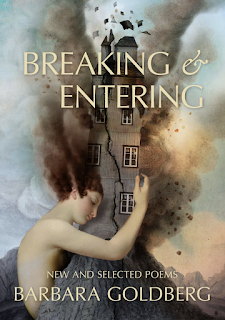
The book’s title Breaking & Entering comes from the poem “Alarums and Excursions” (from Marvelous Pursuits). The poem deals with a modern-day woman who interacts with a security professional, “a man who knows the tricks of breaking/ and entering and how to secure all she holds/ dear from those who would trespass against her.” The cover image, a digital artwork entitled “Tower” by Catrin Welz-Stein shows a youthful nude maiden (a figure like those in Renaissance paintings by Titian) embracing the bottom of a tall building built possibly on a volcano and which is breaking apart and on fire. The nude’s long hair is swept up in the wind of the explosion. The image speaks ably to the explosive emotional content of Goldberg’s book which presciently summons our current day turmoil that deals with place, placement, and power as well as truth and lies.