Sunday, April 30, 2023

The Excellence of the 21st Century Consort


21st Century Consort on April 29, 2023, presented “Echoes of Earth Day,” the last program of this season to a full house at Washington, DC’s St. Mark’s Episcopal Church in its glorious sanctuary with many colorfully grand stain glass windows. The Dresser goes on the record to assert this was an outstanding concert with excellent performances by accomplished musicians and a superb program selected by Artistic Director Christopher Kendall. Central to all the works is an expanded timbral palette.


A last-minute change of composition order featured first  Wang Jie’s “Sonata for the Other Shore” as played passionately by pianist Lisa Emenheiser. This was the American premiere. No doubt that composer Wang Jie who was present found Emenheiser’s performance of this difficult and theatrical composition meeting her expectations.


No less challenging was Juri Seo’s (also present for this concert) “Suite” played masterfully on the cello by Rachel Young. “Suite” in five movements was inspired by and subtly reminiscent of the unaccompanied cello suites of J. S. Bach. The work featured a scordatura tuning of the lowest string and extensive use of harmonics on all the strings.


Absolutely the Dresser’s favorite selection justly positioned to close the first half of the concert was “Whispers” by Sebastian Currier. In this work, percussion executed with dazzling precision by Lee Hinkle accented the equally precise performances of Lisa Emenheiser on piano (using the keys and internal strings of her instrument), Rachel Young on cello, and Sarah Frisof on flute. Not a minute went by without Hinkle’s subtle touch on snare drums, vibraphone, tambourine, and woodblocks.


“Danza de la Mariposa” by Valerie Coleman opened the second half of the program. This delicate and energic tone poem featured flautist Sarah Frisof.


George Crumb’s classic ecologically-themed work “Voix Balaenae” (Voice of the Whale) opens with a recording of whale calls and then moves into response first from flautist Sarah Frisof and then more formally in the segment known as “Sea-theme” by cellist Rachel Young and pianist Lisa Emenheiser. One unusual feature of this work is that the flautist and cellist alternately play antique cymbals. It was certainly this edgy piece by Crumb that motivated the Dresser to go out for this concert and it did not disappoint.


21st Century Consort is an exceptionally notable group of musicians giving voice to contemporary classical music and deserves every bit of publicity it can garner. Washington DC is blessed to have such talent.


Tuesday, April 11, 2023

Playing in The Court of No Record


The Dresser has noticed a swell of poetry collections written in the sway of lawyerly or criminal justice language dealing with misogynistic violence. Some of the books the Dresser has seen are Annie Kim’s Eros, Unbroken (winner of the 2019 Word Works Washington Prize), Susana Case’s The Damage Done (2022: Broadstone Books), various books by Monica Youn (e.g., From From 2023: Graywolf Press) and the focus of this review Jenny Molberg’s The Court of No Record (2023: LSU Press).


Playing in Jenny Molberg’s Court of No Record is a game that is loaded against the crime victim. Operative words for Molberg’s book The Court of No Record are evidence, testimony, and investigation. No worries there is plenty of poetry and it begins right away in the prologue poem entitled poetically and optimistically “ May the Stars Guide You Safely Home.” This is a poem written in couplets and while it begins  with a frightening prosaic declaration, it moves into poetic imagery about the people of America watching a show about an allusive man whose eyes can’t be seen because his eyes are so cold they create a fog on the lenses of his glasses:


After I call the cops to ask for a protective order

I read about the girlfriend of a serial killer. What she knew,


what she didn’t. How it seems we’re always punished

for asking questions. America is watching a show


about a man who is fascinating. His eyes ice

behind the fog of his glasses.


One of the actions that follows is that the narrator describes the call to the police and uses unexpected similes to depict her state of mind:


When I call the cops

I hold my arm like a seatbelt. When I call the cops


a woman answers. Hand over chest like an elementary

school lie: the pledge, the flag, the wrong math.


The arm held like a car’s seatbelt is a protective gesture, but the hand over the chest suggests a lie. However, it is a lie that she says is taught to little children—who must pledge their allegiance to the American flag where we citizens get “liberty and justice for all.”


Other details of this poem reveal that the girlfriend of the serial killer rode in his car which, unbeknownst to her, carried the body of a woman he had killed. However, the said girlfriend had also killed someone. Furthermore, the policewoman tells the narrator that by reporting this man, she could be making the situation worse for herself and that she should get a gun and be prepared to use it. So, the narrator calls a domestic abuse hotline, and they say her abuser has beat her to that hotline first and they can’t talk to her.


This is the stuff of nightmares, and the reader might question if the narrator is locked into disturbing dreams and therefore not telling things as they are:


The night of the hearing I awake thinking

I am the girlfriend, the silence of the trunk


an ocean. It takes hours to rise, to gather myself,

part by part, pulling the truth from the dark.


This is my face. This is my name.

Someone loves me.


My voice is animal in the courtroom microphone.

Behind the judge, the sideways prison of the flag.


Well, yes, she is living a disturbing dream and mixing up information because she is so upset and not getting any help from the justice system. Notice the metaphor that her voice is animal as she tries to give her testimony.


Molberg’s book is divided into three sections. Section I “Expecting” sets up the crime scenes and includes poems drawn from the dioramas of Frances Glessner Lee. The emphasis is on evidence.


Section II “The Court of No Record” is a long poem that deals with testimony in the courtroom. The poetic landscape often alternates between prose poems and a five-line haiku. Metapoesis plays a strong role as the poetry of the narrator becomes an issue in the courtroom. For example, the haiku “Evidence: She Said” is paired with the prose poem “My Testimony.”


Evidence: She Said


The cops?

When he chased me

down an alley, they stood

blue, unmoved. He can spin a badge.

Turn them.


In “My Testimony,” the narrator takes the stand and is badgered by the Alpha who is suing the narrator. However, everyone else—the Alpha’s lawyer and the judge—harass the narrator also. The judge says, “I don’t need to know whether these things happened to her, only if she wrote about them.”


Section III “What Love Does” focuses on a recurring character called “Bitch.” This is Molberg’s investigation of women. The bottom line is that women must become strong like the Bitch in “Bitch Monitoring Your Phone”: “I am a citizen detective. I am a sleuth.”


What Jenny Molberg and other women like Annie Kim, Susana Case and Monica Yuan are doing with their books of poetry is providing witness and testimony to injustices against women and those who are weaker than prevailing authorities. This is not beautiful poetry. This is poetry seeking  awareness and change.


 Photo by Johnny Ulasien

Tuesday, March 21, 2023

Blown Away by Blue


If there is only one opera that an American citizen could ever see, the Dresser believes fervently that opera, a story about race in America, should be Blue with music by Jeanine Tesori  and words by Tazewell Thompson. This is the opera snatched from the Dresser and the Washington DC community and beyond in March 2020 when Covid closed down the Kennedy Center. At long last, the Dresser saw the Washington National Opera (WNO) production on March 19, 2023.


Since its premiere July 14, 2019, during the Glimmerglass Festival, many young black men or boys have lost their lives in the hands of white police officers. Tazewell’s poignant libretto begins with a teenage Black boy who becomes a policeman. He and his wife birth a son who grows up protesting police brutality. The Son is shot and killed by a White cop. Bass Kenneth Kellogg, a graduate of the Duke Ellington School of the Performing and Visual Arts who created the role of The Father at Glimmerglass and has performed it consistently in a string of Blue productions across the United States—Seattle Opera, Michigan Opera Theatre, Toledo Opera, Pittsburgh Opera. Kellogg’s performance, along with Briana Hunter’s as The Mother, stands out for  singing and acting. Hunter is the original mezzo-soprano from the Glimmerglass premiere.


Despite the tragedy of The Boy’s death, this two-hour-and-fifteen-minute work with one intermission and in two acts is well balanced with moments of levity and love. Yet the emotional balance is achieved in the face of racist clichés that label a significant percent of America’s population as “happy Negroes singing spirituals” or “niggers.” While Thompson intends for audience to view his characters as prototypes—no character has a name—their humanity is palpable and deeply moving. When The Mother tells the Girlfriends about how much she loves her husband (The Father) and that they are going to have a baby, a baby boy, they are wary about her husband being police and warn her that a son will be nothing but trouble. Still, they surround her with their loving friendship and are not a Greek chorus of doom.


Likewise, The Father’s fellow officers tease him about how he will become a warden of “baby jail.” Like the Girlfriends, the Policemen show support by letting The Father know they are envious that he will have a son.


Tesori’s music is every bit equal to Thompson’s engrossing libretto. The music is tonal, sometimes jazz inflected, and swells with Copland-like resonances. Often the music is accented with surprising percussion such as celesta and strummed piano strings.


Tesori is a well-known musical composer (e.g., Caroline, or Change, 2003) and WNO produced her children’s opera The Lion, the Unicorn, and Me in 2013. One thing that was disconcerting—Blue is being performed in the Eisenhower Theater where the orchestra pit is too small to accommodate the percussionists. The percussion section was relegated to a remote location. The size of the orchestra pit probably had some influence over WNO’s decision to make this production a chamber version.


Hats off to Tazewell Thompson who also served as the Director. Sets combined projections and furniture moved in and out by the players. The simplicity of the set and the small theater (as opposed to the Kennedy Center’s Opera house) worked very well to create an intimate theater experience. Two performances March 22 and 25 remain. The opera moves next to the English National Opera in London.


Photos by Scott Suchman

Saturday, February 25, 2023

A Debut Poetry Collection from a Master Teacher—Cathy Hailey


A lot is packed into Cathy Hailey’s Finishing Line Press chapbook I’d Rather Be a Hyacinth. All the poems are haiku sonnets. She tells us she learned about this form in The Poetry Gymnasium by Tom Hunley. With a few words to each line, she constructs Shakespearian sonnets with four haiku (most stanzas following the five-seven-five syllable count in three lines) and one rhymed couplet.


Most of the poems deal with nature, either the physical world or human nature as in behavior. There are also ekphrastic poems, the greater number of these describing dance performances. “Under the Sun,” her opening poem about a vase invokes movement and sensation in most lines, a call to find life in seemingly still manmade art.


Under the Sun (an excerpt)


Helios ascends,

bursting urns of golden fire,

glazing graceful winds.


Rhapsodizing lyre

song, strummed by Apollo’s hand,

transcends bound canvas.


The overall title of the collection is found in her last poem of section II.


In Life…


Hyacinths, Purple—

baby blooms adding stress, weight—

instinct maternal.


Tulips variegate

orange-yellow, dancing, coy,

above troupes of green,


singular pride, joy

even with no breeze.

In life, I’d rather


be a hyacinth,

embrace the role of mother,

live the labyrinth,


loved by a brood of florets—

barycenter of orbits.


The poet sees the hyacinth as a mother figure which transcends earthly boundaries as the “barycenter of orbits,” an outer space phenomenon where two or more bodies orbit one another. Elevation and transcendence are what the poet has her creative eye attuned to.


This brings The Dresser to the stunningly beautiful image Cathy Hailey created for the cover of I’d Rather Be a Hyacinth. The image combines a rosebud with the hint of a human profile, butterfly wings as shoulders, a lush display of purple leaves (looking like a ballet tutu), and a pair of stems that seem to represent legs and feet in ballet toe slippers.


But there is one more thing to notice and that’s the final poem and the only poem in Section III entitled “Afterword”. Hailey makes a swipe at “long-winded verse in “In Closing”. The ending couplet redeems:


In Closing (excerpts)


To curb long-winded

verse—haiku, haiku sonnet—

excess rescinded.


There’s magic in condensing,

precision in expressing.


Like many William Shakespeare plays, Hailey provides an epilogue to her collection of haiku sonnets. I’d Rather Be a Hyacinth is a notable first collection from a poet who is gathering her power after years of teaching others about poetry and writing.

Sunday, February 12, 2023

The Visibility of an Artist: Giuseppe De Nittis


The Dresser wasn’t planning to write about “An Italian Impressionist in Paris: Giuseppe De Nittis,” the exhibition that closes today February 12, 2023, at The Phillips Collection. However, several factors congregated in the Dresser’s consciousness that needed outlet.

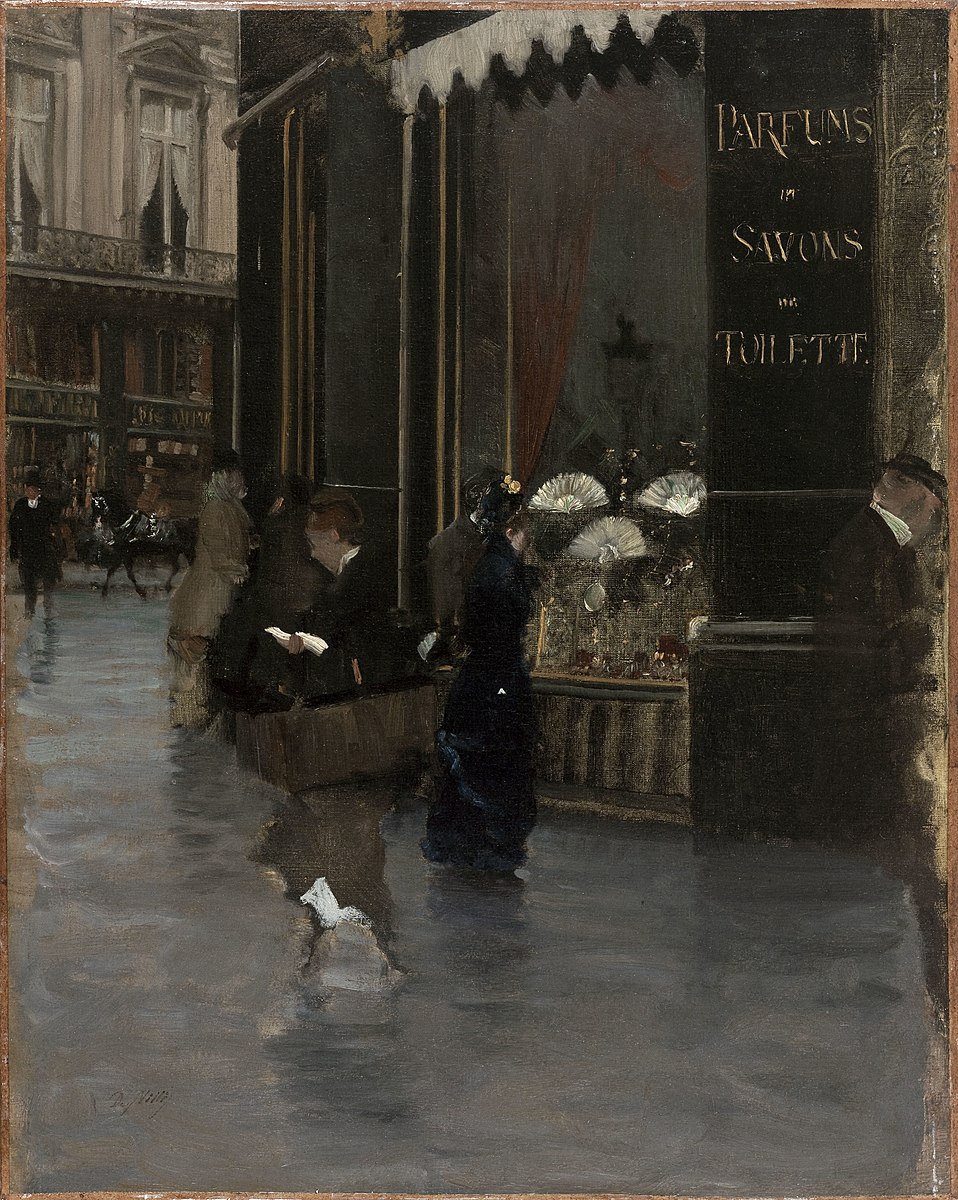
—Number one is that De Nittis sometimes painted in a remarkably engaging Realist style and other times he experimented such that both Realism and Impressionism show up together which seems a contradiction in styles but work fascinatingly well in his paintings. Most striking is La parfumerie Violet where the background figures and buildings appear Realist and the foreground figures are Impressionist (a man at the right side of the canvas whose lower body disappears against the building’s black backdrop and a woman carrying a basket who feet blend with the wet street). 


—Number two is that De Nittis died at age 38 from a stroke and at the rise of his career. A circulating docent at the Phillips said a possible reason he isn’t better known was because the critics were unable to pigeon-hole him while lesser-known Impressionists are much better known.

—Number three is that this exhibition of 73 works, 60 by De Nittis coming from Italy, France, and the United States is not going to be shown anywhere else after it closes.


De Nittis was friends and working colleagues with Edgar Degas, Edouard Manet, and Gustave Caillebotte. Renato Miracco, curator of the De Nittis Art Gallery in Barletta, Italy, and the guest curator of this exhibition shows the influence of these three well known painters on De Nittis. Interestingly, Caillebotte, though considered an Impressionist, painted in a style more known for its realism.


One more painting of De Nittis that the Dresser wants to note is Promenade Hivernale. In this painting, the realistically presented, beautifully dressed woman with melancholy eyes is the painter’s wife. The Impressionistic background shows a Japanese influence.


In the United States, paintings by Giuseppe De Nittis can be seen in such museums as the Metropolitan Museum of Art in New York and the Philadelphia Museum of Art. In Europe, his work can be found in Musée d”Orsay in Paris, the British Museum in London, and the Pinacoteca De Nittis in the Palace of Marra in Barietta, Italy where he was born.


Friday, January 27, 2023

The Important Story of Mary Cardwell Dawson


Washington National Opera, much to the Dresser’s surprise, produced a play with music. The Passion of Mary Cardwell Dawson by playwright Sandra Seaton and composer Carlos Simon tells the little-known story of a Black woman in the 1940s who formed and operated the National Negro Opera Company.


The germ of this play began with WNO’s dramaturg Kelley Rourke who brought Cardwell Dawson’s accomplishments to the attention of Francesca Zambello, WNO Artistic Director. Zambello, in turn, tapped Seaton and Simon to collaborate using this subject matter. In 2020, Seaton and Simon had created a 20-minute opera entitled Night Trip for WNO’s American Opera Initiative, which the Dresser reviewed with deep appreciation.


On January 22, 2023, the Dresser attended Washington National Opera’s production of The Passion of Mary Cardwell Dawson. The setting is Washington, DC in 1943. The backstory is that Cardwell Dawson toured her operatic productions to New York City, Chicago, Pittsburgh, and Washington, DC. In Seaton’s play, the situation is tense—the company is about to open in the out-of-doors on a floating barge in the Potomac River under threatening skies. Even if the performers are willing to sing in the rain, it is unlikely audience will show up and buy tickets. That revenue is vital to the Company’s survival. So, Cardwell Dawson tries to lease an indoor venue, but she is up against segregation practices despite theaters having little luck with white audiences because so many Americans—both white and Black—are away fighting in World War II. Cardwell Dawson stands up for principles and refuses to rent the theater if it means performing for a segregated audience.


The centerpiece of this production is that Mary Cardwell Dawson is played fascinatingly by the celebrated mezzo-soprano Denyce Graves. Graves as Cardwell Dawson is coaching several singers on how to successfully perform Bizet’s opera Carmen, a signature role for Graves which she sung worldwide including WNO and the Met. It was mesmerizing to see her teaching how to imbue passion in the performance to the young singers two of whom (soprano Amber Monroe and tenor Jonathan Pierce Rhodes) are current accomplished Cafritz Young Artists.


However, the music of Carmen overshadows the original and quite appealing music of Carlos Simon. Because this 70-minute piece is focused on Carmen, there are only three original songs. The most memorable original song is “Rebellious Bird,” and that phrase comes from “Habanera,” a song sung by Carmen with this line, “Love is a rebellious bird that no one can tame.”


Mezzo-soprano Taylor-Alexis Dupont plays the singer Phoebe who has landed the coveted role as Carmen much to the disappointment of Isabelle (Amber Monroe). Both singers are memorable for their performances, but Dupont (making her WNO debut) has more opportunity as Carmen to show her singing agility and fiery acting.


Zambello first premiered The Passion of Mary Cardwell Dawson in 2021 at Glimmerglass. This performance was done with piano accompaniment. The work continues to be a piece in development. It is worthy subject matter and has great potential.

Wednesday, January 25, 2023

WNO American Opera Initiative Scores Appreciation


On January 21, 2023, the Dresser attended Washington National Opera production of three twenty-minute operas in its American Opera Initiative (AOI) at the Kennedy Center’s Terrace Theater in Washington, DC. The purpose of AOI, which was founded in January 2012, is to showcase emerging composers and librettists to ensure the life of opera programs in the future. The Cafritz Young Artist program provided accomplished singers for each of the operas presented. The chamber orchestra of musicians from the Washington National Opera Orchestra ably conducted by Evan Rogister brought these young composers’ scores to life in front of a full house of enthusiastic audience of mostly young people.


Musically Oshun by composer B.E. Boykin and librettist Jarrod Lee was the Dresser’s favorite. Through flute and drums, Boykin expressed a west African influence. The libretto featured supernatural spirits that fed into a story about love and redemption. The costumes were eye-catching, especially the red-infused Kente cloth clothing worn by the spirits.


Next on the AOI program came another love story. Prejudice against trans people is the timely and important theme of Walken Schweigert’s libretto for What the Spirits Show as set by composer Silen Wellington. However, the Dresser found the music bland and some of the word settings not quite right.


Bubbie and the Demon by composer Jens Ibsen and librettist Cecelia Raker offered a hilarious Covid isolation story about an old woman whose latest crossword puzzle has unlocked a demon into her home who she thinks is her long-lost Goth grandson. Her neighbor Karen, however, is terrified and tries to persuade her friend that this scary figure is evil. The music is tailored to the character and pulls from different influences, including Mahler. Soprano Teresa Perrotta provides a standout performance as Karen.


Short video interviews of the creative team introduced each of these short operas and the composer-librettist team appeared on stage for a bow after each opera performance. A talk back for this less than an hour program would have helped the audience understand better what they heard and saw.