Friday, January 27, 2023

The Important Story of Mary Cardwell Dawson


Washington National Opera, much to the Dresser’s surprise, produced a play with music. The Passion of Mary Cardwell Dawson by playwright Sandra Seaton and composer Carlos Simon tells the little-known story of a Black woman in the 1940s who formed and operated the National Negro Opera Company.


The germ of this play began with WNO’s dramaturg Kelley Rourke who brought Cardwell Dawson’s accomplishments to the attention of Francesca Zambello, WNO Artistic Director. Zambello, in turn, tapped Seaton and Simon to collaborate using this subject matter. In 2020, Seaton and Simon had created a 20-minute opera entitled Night Trip for WNO’s American Opera Initiative, which the Dresser reviewed with deep appreciation.


On January 22, 2023, the Dresser attended Washington National Opera’s production of The Passion of Mary Cardwell Dawson. The setting is Washington, DC in 1943. The backstory is that Cardwell Dawson toured her operatic productions to New York City, Chicago, Pittsburgh, and Washington, DC. In Seaton’s play, the situation is tense—the company is about to open in the out-of-doors on a floating barge in the Potomac River under threatening skies. Even if the performers are willing to sing in the rain, it is unlikely audience will show up and buy tickets. That revenue is vital to the Company’s survival. So, Cardwell Dawson tries to lease an indoor venue, but she is up against segregation practices despite theaters having little luck with white audiences because so many Americans—both white and Black—are away fighting in World War II. Cardwell Dawson stands up for principles and refuses to rent the theater if it means performing for a segregated audience.


The centerpiece of this production is that Mary Cardwell Dawson is played fascinatingly by the celebrated mezzo-soprano Denyce Graves. Graves as Cardwell Dawson is coaching several singers on how to successfully perform Bizet’s opera Carmen, a signature role for Graves which she sung worldwide including WNO and the Met. It was mesmerizing to see her teaching how to imbue passion in the performance to the young singers two of whom (soprano Amber Monroe and tenor Jonathan Pierce Rhodes) are current accomplished Cafritz Young Artists.


However, the music of Carmen overshadows the original and quite appealing music of Carlos Simon. Because this 70-minute piece is focused on Carmen, there are only three original songs. The most memorable original song is “Rebellious Bird,” and that phrase comes from “Habanera,” a song sung by Carmen with this line, “Love is a rebellious bird that no one can tame.”


Mezzo-soprano Taylor-Alexis Dupont plays the singer Phoebe who has landed the coveted role as Carmen much to the disappointment of Isabelle (Amber Monroe). Both singers are memorable for their performances, but Dupont (making her WNO debut) has more opportunity as Carmen to show her singing agility and fiery acting.


Zambello first premiered The Passion of Mary Cardwell Dawson in 2021 at Glimmerglass. This performance was done with piano accompaniment. The work continues to be a piece in development. It is worthy subject matter and has great potential.

Wednesday, January 25, 2023

WNO American Opera Initiative Scores Appreciation


On January 21, 2023, the Dresser attended Washington National Opera production of three twenty-minute operas in its American Opera Initiative (AOI) at the Kennedy Center’s Terrace Theater in Washington, DC. The purpose of AOI, which was founded in January 2012, is to showcase emerging composers and librettists to ensure the life of opera programs in the future. The Cafritz Young Artist program provided accomplished singers for each of the operas presented. The chamber orchestra of musicians from the Washington National Opera Orchestra ably conducted by Evan Rogister brought these young composers’ scores to life in front of a full house of enthusiastic audience of mostly young people.


Musically Oshun by composer B.E. Boykin and librettist Jarrod Lee was the Dresser’s favorite. Through flute and drums, Boykin expressed a west African influence. The libretto featured supernatural spirits that fed into a story about love and redemption. The costumes were eye-catching, especially the red-infused Kente cloth clothing worn by the spirits.


Next on the AOI program came another love story. Prejudice against trans people is the timely and important theme of Walken Schweigert’s libretto for What the Spirits Show as set by composer Silen Wellington. However, the Dresser found the music bland and some of the word settings not quite right.


Bubbie and the Demon by composer Jens Ibsen and librettist Cecelia Raker offered a hilarious Covid isolation story about an old woman whose latest crossword puzzle has unlocked a demon into her home who she thinks is her long-lost Goth grandson. Her neighbor Karen, however, is terrified and tries to persuade her friend that this scary figure is evil. The music is tailored to the character and pulls from different influences, including Mahler. Soprano Teresa Perrotta provides a standout performance as Karen.


Short video interviews of the creative team introduced each of these short operas and the composer-librettist team appeared on stage for a bow after each opera performance. A talk back for this less than an hour program would have helped the audience understand better what they heard and saw.

Sunday, December 25, 2022

Jane Anger: The Disarming of Shakespeare

 What is a revenge comedy?


The Dresser asks because on December 24, 2022, she saw Talene Monahon’s Jane Anger at the Michael Klein Shakespeare Theatre in Washington, DC. In an exceptionally insightful interview on the Shakespeare Unlimited podcast from the Folger Shakespeare Library conducted by Barbara Bogaev and published December 20, 2022, the playwright said that she initially started writing about William Shakespeare during his plague period when he wrote King Lear. And yes, Monahon wrote Jane Anger during our plague lockdown. Part of her thinking was to make Shakespeare a bad man in a comic play. Her inspirational material was a series of revenge tragedies which are all bloody and campy. Monahon’s revenge comedy takes its lead from Shakespearean revenge tragedies, that includes Hamlet. So, despite the Monty Python humor, Monahon is getting to serious subject matter that involves gender and artistic success.


What is Jane Anger about? Set in the plague year 1606, Shakespeare (Michael Urie), in lockdown, is suffering writer’s block. A former lover of his, one Jane Anger (Amelia Workman), an actual historic figure but her real name is not known, is trying in vain to get her feminist tract Defense of Women published. She is determined and masquerades as a dead man with a large mustache but is foiled by the printer who knew of the man’s death. This, she climbs up a drainpipe and enters Shakespeare’s studio to ask him to sign for her, since women are not allowed to publish. He in turn wants her help getting unblocked and says once King Lear is written, he will sponsor her pamphlet. By her help, he primarily means he wants sex with her.


Before Jane makes her plea to the Bard, he takes on Francis/Frankie, an assistant (Ryan Spahn) who claims to be a sixteen-year-old but is a full-blown adult looking for his break into the world of acting. After Willy (as Jane refers to him) gets his Muse back and starts writing Lear, his wife Anne Hathaway (Talene Monahon) shows up and mayhem breaks loose.


The Dresser loves Jane from the moment she steps on stage to proclaim in direct address to the audience that she is a genius concerned about free will. In Jane’s window entrance into Shakespeare’s studio, she is dressed as a cunning woman, a medieval character (witch) dressed entirely in black with a bird beak masque who has curative powers.


Monahon as Anne Hathaway is everything that Shakespeare complains about—annoying with non-stop talking and, in the Dresser’s view, totally loveable for her childish behavior. Her counterpart is Francis Sir whose effeminate behavior is much like Anne’s—dependent, groveling, and exasperating. This is a farce that flips between Shakespeare’s time and ours with numerous breaches of the Fourth Wall.


One more question—how is it that Monahon is allowed to use the Monty Python skit about the Black Knight who loses his arms? Does she get away with play jism because Jane Anger follows the disarming of Shakespeare by cutting off his willy?


Jane Anger runs through January 8, 2023.

Saturday, November 5, 2022

The Urgency of Publishing Ukrainian War Poems


Recently the Dresser received an early-in-the publishing-process ARC—advance review copy—And Blue will Rise over Yellow: An International Poetry Anthology for Ukraine edited by John Bradley. Like the war Vladimir Putin has exacted on Russia’s neighbor Ukraine, this ARC is shockingly messy with errors that reviewers must ignore to support immediately the spirit that feeds the Ukrainians in the lethal struggle to save themselves, their country, and the democracy they have built in the face of Putin’s plan for their annihilation.


Herein is a peek into four poems of this remarkable collection of which notable blurbist Yusef Komunyakaa states, “Each poem here has risen out of need and feeling, acknowledgement and daring, a choice of weapons.”


Poem #1


Take the clear tomato red my father loved best

after the war—geraniums placed just so…


excerpt from “Sunset Assembly” by Rebecca Foust


To open this war anthology, Bradley chooses a poem that speaks to the time after war where invoking the color red is not to point to blood spilled, but to appreciate the beauty of tomato red geraniums.


Poem #2


dark energy

flashes and bursts


at night I got a call

from my first karate trainer


he said he wants to kill putin

admits

that first he tried himself

to send energy currents

…


insists

that we need to join forces


…

we need at least a hundred molfars

...


excerpt from “A Good Plan” by Dmytro Lazukin as translated by Tatiana Retivov


Energy is a keyword in Putin’s war on Ukraine. Putin’s personal energy tied up with narcistic power-mongering is possibly that “dark energy” flashing and bursting as Dmytro Lazukin’s poem “A Good Plan” opens. Lazukin assigns the risky statement of killing “putin” (notice the disrespectful lowercase spelling) to his “first karate trainer,” an unidentified martial arts advisor. The unexpected twist is that killing energy currents will be produced magically by Ukrainian shamans known as molfars.


Poem #3


In a damp basement in Avdiivka,

a six-year-old girl named Varvara

draws a green alien with a black


eye that can see into the infinitely


finite future. It sees Vladimir Putin,

feet up on his 55-ton desk, staring at a photo

of Joseph Stalin. …


excerpt from “Bomb-Shelter Futurism” by John Bradley


With his own poem, editor John Bradley captures the heart-breaking role a child plays in the trajectory of this surreal war. Sequestered in a bomb-shelter, the six-year-old Varvara draws a cyclops, a green alien to her world, who Bradley says can see into a finite future that contradictorily is endless and which sees Putin at his desk admiring a photo of his predecessor Joseph Stalin, a man of monstrous deeds.


Poem #4


Where a woman, hand full of sunflowers

Dwarfs a tyrant, shames a soldier

Lays a curse upon cowards

There we who are small and watching

Merely watching, safe behind screens

Are maybe redeemed

And blue will rise over yellow


excerpt from “They Will Bloom When You Die” by Douglas Anthony Cooper


“They Will Bloom When You Die” is the last poem of the anthology and it is from where the anthology title derives. It opens as the first poem opens with flowers as a symbol of life. In “Sunset Assembly,” the geraniums represent art and civilization. In “They Will Bloom When You Die,” the sunflowers represent defiant living strength over an unnamed tyrant who is smaller than the sunflower. Is it the soldier standing in front of the defiant woman or the very small-in-stature Putin? Notice that the woman “lays a curse upon cowards.” Who are those people “safe behind screens”—her neighbors peering out their screened windows or doors or we readers on our computers not stepping up to help the people of Ukraine?


Each of these four poems have much more to discover. The anthology includes such well-known/well-published poets as D. Nurkse, Andrea Hollander, Linda Nemec Foster, Kim Stafford, Norman Dubie. The choice of weapon is the pen. Look for this risk-taking collection from Kallisto Gaia Press at the end of 2022.

Tuesday, October 4, 2022

21st Century Consort Features the Works of Women Composers


On October 1, 2022, the 21st Century Consort under the artistic direction of Christopher Kendall and hosted by the Hirshhorn Museum in Washington, DC, presented Threnody, a rare and accomplished concert of mostly women composers. The Dresser notes that the two-hour concert included works by seven contemporary women and the late David Froom, who served on the board of directors for the 21st Century Consort. Most of the compositions dealt with loss and grieving which speaks thematically to Threnody, the title of this program.


The program opened with Armenian-American Tatev Amiryan’s serene composition for piano  Tristesse, in which the composer pays homage to the Armenian composer Komitas (1869-1935). Komitas suffered an irrecoverable mental breakdown in 1915 after witnessing horrors of the Armenian Genocide. Pianist Lisa Emenheiser performed with poetic aplomb, giving even the single notes of this work dramatically deserved emphasis.


Following next, Susan Kander’s composition And Then Not was performed by clarinetist Paul Cigan and percussionist Lee Hinkle. A sometimes strident work, it features interesting textures and a full range of sound and tone achieved with several different kinds of clarinets, including the bass clarinet and a wide variety of percussion instruments, such as drums, wood block, bells, marimba and timpani.


Next, violinist Ying Fu delivered an outstanding performance of Elena Ruehr’s sweet lyricism of Klein Suite in two movements.


Concluding the first half of the program was David Froom’s Lament for the City in an arrangement by Juri Seo. As Kendall explained in the pre-concert talk, Froom originally arranged this piece for the period instruments of the Folger Consort. Froom took inspiration from his collaboration partner Sue Standing’s poem that deals with tikkun olam which in Jewish practice concerns finding a way to repair what is broken in the world. The richly satisfying work included baritone voice, guitar, violin, viola, cello, flute, saxophone, and percussion. Baritone William Sharp’s well enunciated interpretation of Standing’s poem provided the only access to the text which did not apprear in the printed program. Colin Davin on guitar struck notes reminiscent of mandolin and the sounds of Sarah Frisof on flute floated above the lyricism of the standard modern strings. A bit disturbing to this revery was the intrusive tapping of Lee Hinkle on the tambour. However, maybe Froom meant this off-kilter sound to be the reminder of broken things in the world.


Stacy Garrop’s five-part Pieces of Sanity for piano and saxophone opened the second half of the concert. The movements Rage, Despair, Possessed, Stoic are meant to jar the listener. Saxophonist Doug O’Conner bore down on the high notes of Rage and Possessed in an almost uncomfortably loud performance. In the middle movement Euphoria, Lisa Emenheiser demonstrated her mesmerizing prowess at the piano to deliver a surprisingly serene oasis of sound.


Alexandra Gardner’s The Way of Ideas followed with an engaging percolating run of notes that sounded and stopped. Playing this work were Paul Cigan on clarinet, Sarah Frisof on flute, Derek Powell on violin, and Rachel Young on cello.


Dark Ground by Tansy Davies is a solo percussion work and given the variety of percussive instruments displayed on stage for this concert, the Dresser expected an exciting and exotic cocktail of sound. The program notes from Ms. Davies indicate that her composition is rooted in the pedal bass drum which she describes as “a dead sound.” The Dresser suggests that maybe percussionist Lee Hinkle was hamstrung by the composer’s written comments.


Respiri by Juri Seo completed the program and was played by Daniel Foster on viola, Derke Powell on violin, Ying Fu on violin, and Rachel Young on cello. The work is dedicated to composer Jonathan Harvey who dying from a motor neuron disease during the time Seo was corresponding with him. He died in 2012. Respiri is a solemn but bright musical composition that puts the listener in touch with breathing and the firing neurons of the brain. Seo’s work was a satisfying conclusion to an overall enjoyable concert.


Kudos to Christopher Kendall for putting together a concert of depth, variety, and display of musical virtuosity.


Sunday, September 11, 2022

From Old Roots—New Orpheus Opera


The IN Series of Washington, DC under the direction of Timothy Nelson and in partnership with Theatre Nogaku (an international Noh drama group) premiered an extraordinary new opera entitled The Nightsong of Orpheus. The Dresser attended the opening night performance September 9, 2022. The work is an amalgam of story, music, and dance based on two Claudio Monteverdi compositions: Vespers and L’Orfeo as performed by the Innovãtiõ Baroque Orchestra, Akira Matsui—master teacher-artist of the Kita School of classical Noh, and a cast seven singers. This intimate production, presented first at the Source Theatre (later performances run at the Dupont Underground), features a runway stage with limited audience seating on either side with the orchestra positioned at one end of audience seating.


Monteverdi’s L’Orfeo is based on the Greek myth that tells the love story of Orpheus and Eurydice, her death, and his attempt to bring her back to life.  Nightsong uses Christopher Cowell’s English translation of Alessandro Striggio’s L’Orfeo (Italian) libretto.


Monteverdi’s Vespers is a sacred composition venerating Mary, mother of Christ, and her praise of God. It was written in the same year as L’Orfeo and shares some of the same music. Segments of Vespers presented by the Noh characters of Nightsong are in Japanese as translated by Eiki Isomura.


The singing talent for this production was considerable. Given how small the theater space was, the sound vibrations were not only heard but felt. Standout performers were mezzo-soprano Janna Critz, baritone Robin McGinness, and countertenor Hunter Shaner.


The baroque orchestra included harpsichord, organ, two strolling violins, treble viola da gamba, bass gamba, theorbo, and two instruments used in Noh theater—fue (bamboo flute) and taiko (drum).  Music and stage director Timothy Nelson’s decision to send the violinists around the stage brought emphasis to the orchestra’s musical importance and fine performance.


Kudos to Movement Director Jubilith Moore of Theatre Nogaku who included tai chi movements in the dance choreography which exuded joyful energy and precision.


The Noh costumes and masks added color to the mostly black-pants-white-shirts outfits of the singers. Japanese toe socks were worn by all the players except Orpheus (tenor Tony Boutteé) who was barefoot.


Another unexpected and exotic element involved calligraphic painting on the papered floor of the runway stage. In the tradition of ephemeral brushstroke art, the papered floor was torn away at the end of the production to signal that human life (i.e., that of Orpheus and Euridice) and its stories were limited.


Historians and critics agree that L’Orfeo marks the beginning of great opera. With The Nightsong of Orpheus that combines early baroque music with centuries old Far Eastern theater, the IN Series has given opera as an artistic discipline and the work of Monteverdi a fresh framework for current day theatergoers to discover, absorb, and enjoy.


Photos by: Bayou Elom


Wednesday, August 10, 2022

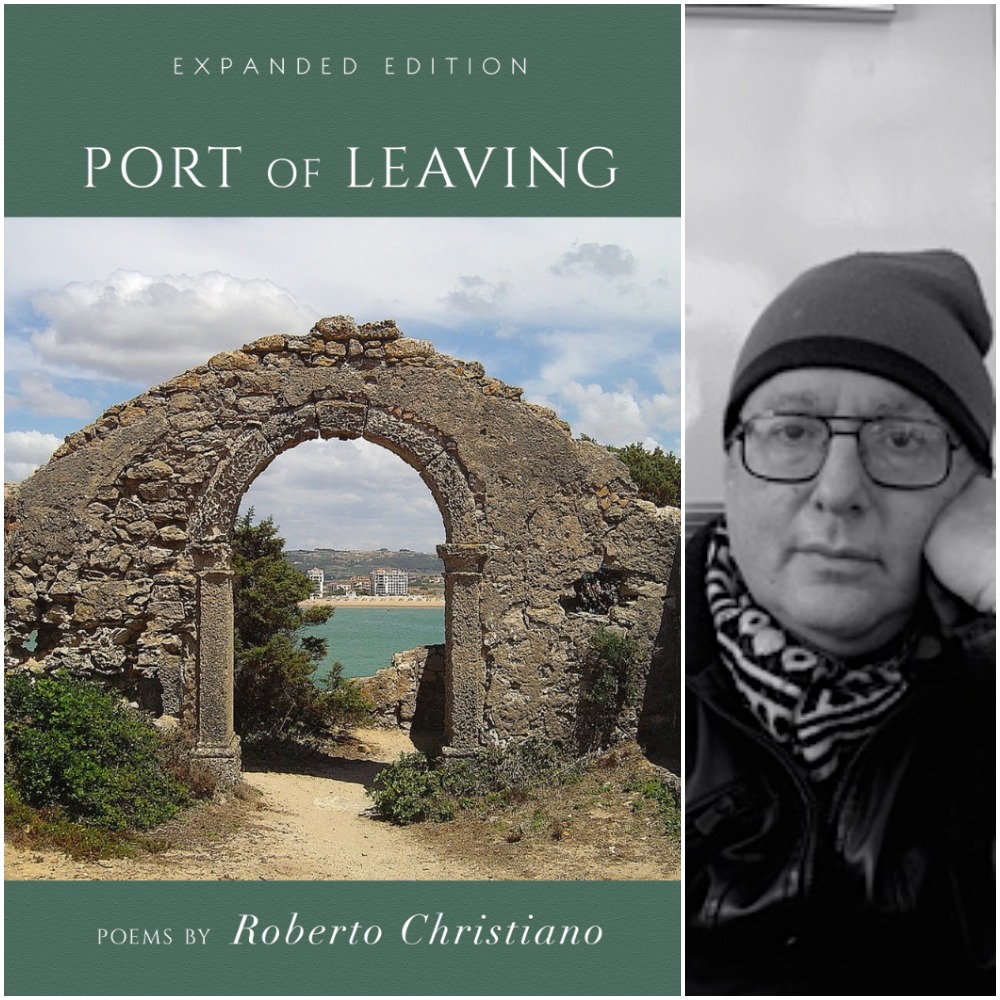
The Fado of Port of Leaving


Port of Leaving, a collection of poetry from Finishing Line Press, by Roberto Christiano is a journey into the suffering inherent within the human condition. The origin of this poet’s suffering emanates ancestrally and psychically from the Portuguese port of departure (leaving) Salir do Porto and includes the hard-to-define Portuguese word saudade. Saudade infuses into suffering a longing for something that may never be achieved.


Christiano’s yearning (saudade) initially springs from the love and acceptance he wanted from his Portuguese father, a man who was a bricklayer.


Driving through Georgetown
on a congested Friday afternoon,
I find myself stopped
behind a truckload of bricks
when my father comes to me—
red brown in his Portuguese skin.
“I’m a bricklayer by trade,”
he often says,
and his hands show it—
all calloused like tree bark.

excerpt from “My Father Is a Bricklayer”

Despite his father not speaking English well and disapproving of the poet’s choice of a career in acting, this man would attend his son’s performances.


Although my father never approved of acting,

he came to see every play I was in.
His favorites were A Midsummer Night’s Dream

and Macbeth. …


My father’s choices bewildered me—

he spoke a broken English at best,

and the only thing he read
was the front page of the paper.


excerpt from “My Father and Shakespeare at the Sylvan Amphitheater”


 As a child, the poet was not allowed by his father to speak during dinner, so he tested his father (who loved to play the accordion) by singing.


I was not permitted a word at dinner

because you were too hot from laying

brick in the sun to bear the voices
of children …

Sometimes I ventured a phrase,

but you pushed me down quick.
“You no speak. You have no responsibility.”

The r in responsibility you would hit
with a rough Portuguese trill.

…

I watched how playing your accordion

for hours into the night soothed you.

Above the keys in gleaming silver

cursive was written Excelsior.

Since the accordion weighed too much

to pick up, I began to sing—
often in the middle of dinner.


excerpt from “Why I Sang at Dinner”


The poet suggests by noting the word Excelsior that the accordion had a higher purpose. His father neither stopped his son from singing nor showed approval.


In the wake of the father’s inability to verbally express the love and acceptance his son wanted, Christiano’s narrative, free verse or prose poems are often emotionally flat, but not so in his title poem “Salir do Porto” which ends with these lines:


I will not find the words to say to you—

little leaving port of Portugal
to whom I am forever returning.

What words could ever say
how he left me who cannot swim,

standing on your shore of sorrow?


Truth-telling and clarity comes across with this writing style of emotional flatness which invites the reader to reflect deeply on what the poet has presented. For example, in “Flight,”  we learn about the painstaking efforts the father makes to save a baby bird.


A baby blackbird
falls from a nest.
He struggles
to fly and fails.
My father picks him up,

sticks him in a cage,
puts him in the basement.

The blackbird refuses

the worms I offer him,
the same with flax seeds.

Father mashes leftover bread,

takes the blackbird
in his bricklayer hands,
feeds him mouth to beak.

…


The son tries to feed the bird but fails. The father succeeds and releases the blackbird into the “cold, crisp air” and the bird opens his wings and flies. The emotion that the narrator (son) feels (What if he can’t fly?—because he is the empathic one) is down played. The mood shifts to neutral because nature takes over—the father releases the bird. There is no drama. The son’s angst is down played and so there is, in this reviewer’s opinion, an emotional flatness providing clarity in just stating what happened. This writing approach makes room for seeing the quiet goodness and parental leadership of the father.


“He will fly,”

Father says,

pushing open the screen door,

advancing into the backyard.


With both hands,
he throws the blackbird

into the cold, crisp air

…


Sections 2 and 3 of Port of Leaving open outward to Relatives and Portugal and the World. However, the poet’s father is present in these two sections of the book as well. For example, in “Coke Memories”, the featured relative is the poet’s Great Aunt Anna who “remembers when the real thing/ first came out” and how Coke made one feel good. After all the poet writes:


In 1886, Coke first appeared
as a patented medicine—
a digestive and headache remedy

as well as an impotence aid.

Each glass contained nine

milligrams of cocaine.


The poem ends with the poet’s father thinking Coke would cure his acne:

He pedaled barefoot
on a bicycle
through miles and miles

of poverty and sorrow

to buy a Coke

because he believed

it would cure him.


The last section of the book reveals a family secret—the poet’s family had Jews who converted to Catholicism. Several times the poet asks his father what happened to the Jews? (First in section 1 “Hitler’s Trains” and later Section 3 “The Past Is Never Dead.” The poet provides the explanation in “The Wars of Rosemary and Marjoram”:


My father’s town was founded by two families—the Cristãos and the Alecrims.

The two families intermarried. My grandparents were first cousins.
We all turned out inbred, depressed, and nearsighted.


In 1497, Manoel the First of Portugal demanded that all Jews convert or leave.

Some left. Some converted. Some pretended. Some changed their names
to the names of herbs. They were called the New Christians or Conversos—

the converted ones.


Somewhere along the line in America, Cristão proved too challenging

and turned into Christiano. I came to hate it. I always thought Christiano

sounded like a stage name. And then there was history—
the history of Christianity to salt the wound.


In the rollicking 1730’s, the toast of the Lisbon theatre
was Antonio José da Silva. He wrote delicious skits with songs
satirizing politics and the bourgeoisie. Most of his plays were for puppets.

His big hit was The Wars of Rosemary and Marjoram.
The King just adored him. His nickname was The Jew.


Every Thanksgiving my favorite cousin, Elizabet Alecrim, tells me all the dirt,

…


I invite Cousin Elizabet to sit in the seat of honor. I begin to carve

the clove studded ham. She pours herself some wine and says,

“Have I told you yet that we have Jewish blood in the family?
After all these years, I did the Ancestry thing, and well, now I know

why Alecrim means rosemary.”


Port of Leaving by Roberto Christiano is a compelling journey of self-examination that opens out to the world we live in. It is a song in the fado tradition—“Blues of Longing”. It’s a tradition that Christiano willingly shares:


What I sang was sadness.
It was not my sadness.

It was ours.


excerpt from “Memoir”