Saturday, November 5, 2022

The Urgency of Publishing Ukrainian War Poems


Recently the Dresser received an early-in-the publishing-process ARC—advance review copy—And Blue will Rise over Yellow: An International Poetry Anthology for Ukraine edited by John Bradley. Like the war Vladimir Putin has exacted on Russia’s neighbor Ukraine, this ARC is shockingly messy with errors that reviewers must ignore to support immediately the spirit that feeds the Ukrainians in the lethal struggle to save themselves, their country, and the democracy they have built in the face of Putin’s plan for their annihilation.


Herein is a peek into four poems of this remarkable collection of which notable blurbist Yusef Komunyakaa states, “Each poem here has risen out of need and feeling, acknowledgement and daring, a choice of weapons.”


Poem #1


Take the clear tomato red my father loved best

after the war—geraniums placed just so…


excerpt from “Sunset Assembly” by Rebecca Foust


To open this war anthology, Bradley chooses a poem that speaks to the time after war where invoking the color red is not to point to blood spilled, but to appreciate the beauty of tomato red geraniums.


Poem #2


dark energy

flashes and bursts


at night I got a call

from my first karate trainer


he said he wants to kill putin

admits

that first he tried himself

to send energy currents

…


insists

that we need to join forces


…

we need at least a hundred molfars

...


excerpt from “A Good Plan” by Dmytro Lazukin as translated by Tatiana Retivov


Energy is a keyword in Putin’s war on Ukraine. Putin’s personal energy tied up with narcistic power-mongering is possibly that “dark energy” flashing and bursting as Dmytro Lazukin’s poem “A Good Plan” opens. Lazukin assigns the risky statement of killing “putin” (notice the disrespectful lowercase spelling) to his “first karate trainer,” an unidentified martial arts advisor. The unexpected twist is that killing energy currents will be produced magically by Ukrainian shamans known as molfars.


Poem #3


In a damp basement in Avdiivka,

a six-year-old girl named Varvara

draws a green alien with a black


eye that can see into the infinitely


finite future. It sees Vladimir Putin,

feet up on his 55-ton desk, staring at a photo

of Joseph Stalin. …


excerpt from “Bomb-Shelter Futurism” by John Bradley


With his own poem, editor John Bradley captures the heart-breaking role a child plays in the trajectory of this surreal war. Sequestered in a bomb-shelter, the six-year-old Varvara draws a cyclops, a green alien to her world, who Bradley says can see into a finite future that contradictorily is endless and which sees Putin at his desk admiring a photo of his predecessor Joseph Stalin, a man of monstrous deeds.


Poem #4


Where a woman, hand full of sunflowers

Dwarfs a tyrant, shames a soldier

Lays a curse upon cowards

There we who are small and watching

Merely watching, safe behind screens

Are maybe redeemed

And blue will rise over yellow


excerpt from “They Will Bloom When You Die” by Douglas Anthony Cooper


“They Will Bloom When You Die” is the last poem of the anthology and it is from where the anthology title derives. It opens as the first poem opens with flowers as a symbol of life. In “Sunset Assembly,” the geraniums represent art and civilization. In “They Will Bloom When You Die,” the sunflowers represent defiant living strength over an unnamed tyrant who is smaller than the sunflower. Is it the soldier standing in front of the defiant woman or the very small-in-stature Putin? Notice that the woman “lays a curse upon cowards.” Who are those people “safe behind screens”—her neighbors peering out their screened windows or doors or we readers on our computers not stepping up to help the people of Ukraine?


Each of these four poems have much more to discover. The anthology includes such well-known/well-published poets as D. Nurkse, Andrea Hollander, Linda Nemec Foster, Kim Stafford, Norman Dubie. The choice of weapon is the pen. Look for this risk-taking collection from Kallisto Gaia Press at the end of 2022.

Tuesday, October 4, 2022

21st Century Consort Features the Works of Women Composers


On October 1, 2022, the 21st Century Consort under the artistic direction of Christopher Kendall and hosted by the Hirshhorn Museum in Washington, DC, presented Threnody, a rare and accomplished concert of mostly women composers. The Dresser notes that the two-hour concert included works by seven contemporary women and the late David Froom, who served on the board of directors for the 21st Century Consort. Most of the compositions dealt with loss and grieving which speaks thematically to Threnody, the title of this program.


The program opened with Armenian-American Tatev Amiryan’s serene composition for piano  Tristesse, in which the composer pays homage to the Armenian composer Komitas (1869-1935). Komitas suffered an irrecoverable mental breakdown in 1915 after witnessing horrors of the Armenian Genocide. Pianist Lisa Emenheiser performed with poetic aplomb, giving even the single notes of this work dramatically deserved emphasis.


Following next, Susan Kander’s composition And Then Not was performed by clarinetist Paul Cigan and percussionist Lee Hinkle. A sometimes strident work, it features interesting textures and a full range of sound and tone achieved with several different kinds of clarinets, including the bass clarinet and a wide variety of percussion instruments, such as drums, wood block, bells, marimba and timpani.


Next, violinist Ying Fu delivered an outstanding performance of Elena Ruehr’s sweet lyricism of Klein Suite in two movements.


Concluding the first half of the program was David Froom’s Lament for the City in an arrangement by Juri Seo. As Kendall explained in the pre-concert talk, Froom originally arranged this piece for the period instruments of the Folger Consort. Froom took inspiration from his collaboration partner Sue Standing’s poem that deals with tikkun olam which in Jewish practice concerns finding a way to repair what is broken in the world. The richly satisfying work included baritone voice, guitar, violin, viola, cello, flute, saxophone, and percussion. Baritone William Sharp’s well enunciated interpretation of Standing’s poem provided the only access to the text which did not apprear in the printed program. Colin Davin on guitar struck notes reminiscent of mandolin and the sounds of Sarah Frisof on flute floated above the lyricism of the standard modern strings. A bit disturbing to this revery was the intrusive tapping of Lee Hinkle on the tambour. However, maybe Froom meant this off-kilter sound to be the reminder of broken things in the world.


Stacy Garrop’s five-part Pieces of Sanity for piano and saxophone opened the second half of the concert. The movements Rage, Despair, Possessed, Stoic are meant to jar the listener. Saxophonist Doug O’Conner bore down on the high notes of Rage and Possessed in an almost uncomfortably loud performance. In the middle movement Euphoria, Lisa Emenheiser demonstrated her mesmerizing prowess at the piano to deliver a surprisingly serene oasis of sound.


Alexandra Gardner’s The Way of Ideas followed with an engaging percolating run of notes that sounded and stopped. Playing this work were Paul Cigan on clarinet, Sarah Frisof on flute, Derek Powell on violin, and Rachel Young on cello.


Dark Ground by Tansy Davies is a solo percussion work and given the variety of percussive instruments displayed on stage for this concert, the Dresser expected an exciting and exotic cocktail of sound. The program notes from Ms. Davies indicate that her composition is rooted in the pedal bass drum which she describes as “a dead sound.” The Dresser suggests that maybe percussionist Lee Hinkle was hamstrung by the composer’s written comments.


Respiri by Juri Seo completed the program and was played by Daniel Foster on viola, Derke Powell on violin, Ying Fu on violin, and Rachel Young on cello. The work is dedicated to composer Jonathan Harvey who dying from a motor neuron disease during the time Seo was corresponding with him. He died in 2012. Respiri is a solemn but bright musical composition that puts the listener in touch with breathing and the firing neurons of the brain. Seo’s work was a satisfying conclusion to an overall enjoyable concert.


Kudos to Christopher Kendall for putting together a concert of depth, variety, and display of musical virtuosity.


Sunday, September 11, 2022

From Old Roots—New Orpheus Opera


The IN Series of Washington, DC under the direction of Timothy Nelson and in partnership with Theatre Nogaku (an international Noh drama group) premiered an extraordinary new opera entitled The Nightsong of Orpheus. The Dresser attended the opening night performance September 9, 2022. The work is an amalgam of story, music, and dance based on two Claudio Monteverdi compositions: Vespers and L’Orfeo as performed by the Innovãtiõ Baroque Orchestra, Akira Matsui—master teacher-artist of the Kita School of classical Noh, and a cast seven singers. This intimate production, presented first at the Source Theatre (later performances run at the Dupont Underground), features a runway stage with limited audience seating on either side with the orchestra positioned at one end of audience seating.


Monteverdi’s L’Orfeo is based on the Greek myth that tells the love story of Orpheus and Eurydice, her death, and his attempt to bring her back to life.  Nightsong uses Christopher Cowell’s English translation of Alessandro Striggio’s L’Orfeo (Italian) libretto.


Monteverdi’s Vespers is a sacred composition venerating Mary, mother of Christ, and her praise of God. It was written in the same year as L’Orfeo and shares some of the same music. Segments of Vespers presented by the Noh characters of Nightsong are in Japanese as translated by Eiki Isomura.


The singing talent for this production was considerable. Given how small the theater space was, the sound vibrations were not only heard but felt. Standout performers were mezzo-soprano Janna Critz, baritone Robin McGinness, and countertenor Hunter Shaner.


The baroque orchestra included harpsichord, organ, two strolling violins, treble viola da gamba, bass gamba, theorbo, and two instruments used in Noh theater—fue (bamboo flute) and taiko (drum).  Music and stage director Timothy Nelson’s decision to send the violinists around the stage brought emphasis to the orchestra’s musical importance and fine performance.


Kudos to Movement Director Jubilith Moore of Theatre Nogaku who included tai chi movements in the dance choreography which exuded joyful energy and precision.


The Noh costumes and masks added color to the mostly black-pants-white-shirts outfits of the singers. Japanese toe socks were worn by all the players except Orpheus (tenor Tony Boutteé) who was barefoot.


Another unexpected and exotic element involved calligraphic painting on the papered floor of the runway stage. In the tradition of ephemeral brushstroke art, the papered floor was torn away at the end of the production to signal that human life (i.e., that of Orpheus and Euridice) and its stories were limited.


Historians and critics agree that L’Orfeo marks the beginning of great opera. With The Nightsong of Orpheus that combines early baroque music with centuries old Far Eastern theater, the IN Series has given opera as an artistic discipline and the work of Monteverdi a fresh framework for current day theatergoers to discover, absorb, and enjoy.


Photos by: Bayou Elom


Wednesday, August 10, 2022

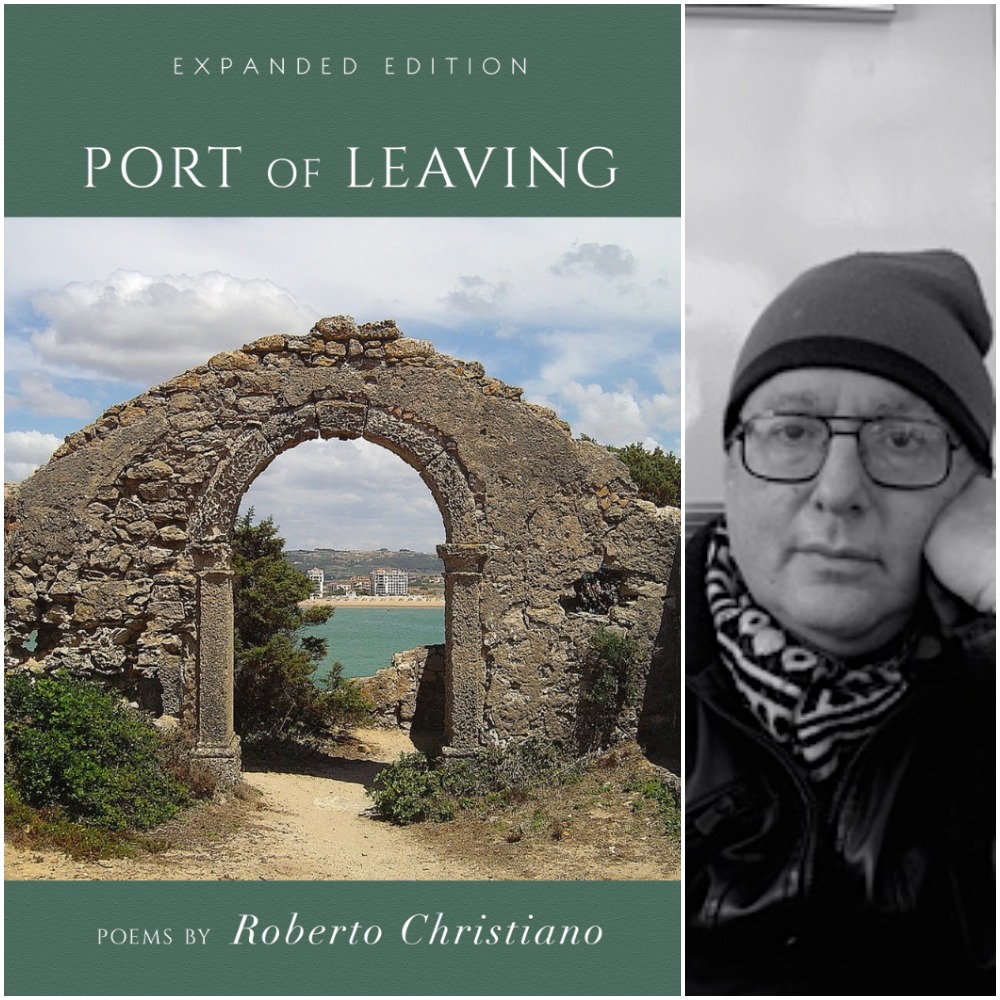
The Fado of Port of Leaving


Port of Leaving, a collection of poetry from Finishing Line Press, by Roberto Christiano is a journey into the suffering inherent within the human condition. The origin of this poet’s suffering emanates ancestrally and psychically from the Portuguese port of departure (leaving) Salir do Porto and includes the hard-to-define Portuguese word saudade. Saudade infuses into suffering a longing for something that may never be achieved.


Christiano’s yearning (saudade) initially springs from the love and acceptance he wanted from his Portuguese father, a man who was a bricklayer.


Driving through Georgetown
on a congested Friday afternoon,
I find myself stopped
behind a truckload of bricks
when my father comes to me—
red brown in his Portuguese skin.
“I’m a bricklayer by trade,”
he often says,
and his hands show it—
all calloused like tree bark.

excerpt from “My Father Is a Bricklayer”

Despite his father not speaking English well and disapproving of the poet’s choice of a career in acting, this man would attend his son’s performances.


Although my father never approved of acting,

he came to see every play I was in.
His favorites were A Midsummer Night’s Dream

and Macbeth. …


My father’s choices bewildered me—

he spoke a broken English at best,

and the only thing he read
was the front page of the paper.


excerpt from “My Father and Shakespeare at the Sylvan Amphitheater”


 As a child, the poet was not allowed by his father to speak during dinner, so he tested his father (who loved to play the accordion) by singing.


I was not permitted a word at dinner

because you were too hot from laying

brick in the sun to bear the voices
of children …

Sometimes I ventured a phrase,

but you pushed me down quick.
“You no speak. You have no responsibility.”

The r in responsibility you would hit
with a rough Portuguese trill.

…

I watched how playing your accordion

for hours into the night soothed you.

Above the keys in gleaming silver

cursive was written Excelsior.

Since the accordion weighed too much

to pick up, I began to sing—
often in the middle of dinner.


excerpt from “Why I Sang at Dinner”


The poet suggests by noting the word Excelsior that the accordion had a higher purpose. His father neither stopped his son from singing nor showed approval.


In the wake of the father’s inability to verbally express the love and acceptance his son wanted, Christiano’s narrative, free verse or prose poems are often emotionally flat, but not so in his title poem “Salir do Porto” which ends with these lines:


I will not find the words to say to you—

little leaving port of Portugal
to whom I am forever returning.

What words could ever say
how he left me who cannot swim,

standing on your shore of sorrow?


Truth-telling and clarity comes across with this writing style of emotional flatness which invites the reader to reflect deeply on what the poet has presented. For example, in “Flight,”  we learn about the painstaking efforts the father makes to save a baby bird.


A baby blackbird
falls from a nest.
He struggles
to fly and fails.
My father picks him up,

sticks him in a cage,
puts him in the basement.

The blackbird refuses

the worms I offer him,
the same with flax seeds.

Father mashes leftover bread,

takes the blackbird
in his bricklayer hands,
feeds him mouth to beak.

…


The son tries to feed the bird but fails. The father succeeds and releases the blackbird into the “cold, crisp air” and the bird opens his wings and flies. The emotion that the narrator (son) feels (What if he can’t fly?—because he is the empathic one) is down played. The mood shifts to neutral because nature takes over—the father releases the bird. There is no drama. The son’s angst is down played and so there is, in this reviewer’s opinion, an emotional flatness providing clarity in just stating what happened. This writing approach makes room for seeing the quiet goodness and parental leadership of the father.


“He will fly,”

Father says,

pushing open the screen door,

advancing into the backyard.


With both hands,
he throws the blackbird

into the cold, crisp air

…


Sections 2 and 3 of Port of Leaving open outward to Relatives and Portugal and the World. However, the poet’s father is present in these two sections of the book as well. For example, in “Coke Memories”, the featured relative is the poet’s Great Aunt Anna who “remembers when the real thing/ first came out” and how Coke made one feel good. After all the poet writes:


In 1886, Coke first appeared
as a patented medicine—
a digestive and headache remedy

as well as an impotence aid.

Each glass contained nine

milligrams of cocaine.


The poem ends with the poet’s father thinking Coke would cure his acne:

He pedaled barefoot
on a bicycle
through miles and miles

of poverty and sorrow

to buy a Coke

because he believed

it would cure him.


The last section of the book reveals a family secret—the poet’s family had Jews who converted to Catholicism. Several times the poet asks his father what happened to the Jews? (First in section 1 “Hitler’s Trains” and later Section 3 “The Past Is Never Dead.” The poet provides the explanation in “The Wars of Rosemary and Marjoram”:


My father’s town was founded by two families—the Cristãos and the Alecrims.

The two families intermarried. My grandparents were first cousins.
We all turned out inbred, depressed, and nearsighted.


In 1497, Manoel the First of Portugal demanded that all Jews convert or leave.

Some left. Some converted. Some pretended. Some changed their names
to the names of herbs. They were called the New Christians or Conversos—

the converted ones.


Somewhere along the line in America, Cristão proved too challenging

and turned into Christiano. I came to hate it. I always thought Christiano

sounded like a stage name. And then there was history—
the history of Christianity to salt the wound.


In the rollicking 1730’s, the toast of the Lisbon theatre
was Antonio José da Silva. He wrote delicious skits with songs
satirizing politics and the bourgeoisie. Most of his plays were for puppets.

His big hit was The Wars of Rosemary and Marjoram.
The King just adored him. His nickname was The Jew.


Every Thanksgiving my favorite cousin, Elizabet Alecrim, tells me all the dirt,

…


I invite Cousin Elizabet to sit in the seat of honor. I begin to carve

the clove studded ham. She pours herself some wine and says,

“Have I told you yet that we have Jewish blood in the family?
After all these years, I did the Ancestry thing, and well, now I know

why Alecrim means rosemary.”


Port of Leaving by Roberto Christiano is a compelling journey of self-examination that opens out to the world we live in. It is a song in the fado tradition—“Blues of Longing”. It’s a tradition that Christiano willingly shares:


What I sang was sadness.
It was not my sadness.

It was ours.


excerpt from “Memoir”


Thursday, May 26, 2022

Hurry: Waning Days “Picasso: Painting the Blue Period” at Phillips Collection


If you have been dawdling about whether to see “Picasso: Painting the Blue Period” at Washington, DC’s Phillips Collection, the Dresser urges you to book your ticket now before the exhibition closes June 12, 2022.


Here are several reasons you might want to see this show.


—It is well curated. There is just enough text to give you the information needed to understand this period  of Picasso’s work. There is also enough breathing space between the Blue Period paintings so that you can get close to the work without other visitors to the museum getting in your way. There is also an audio guide you can access by QR code. Be sure to bring your headset if you prefer this method.


—Three of the paintings were done on top of another painting, including the well known The Blue Room (1901) oil on canvas which is owned by the Phillips Collection. Exhibition videos and photos show you what is underneath these three paintings and the process used in the discoveries.


—Influences on Picasso during this period are shown with his work leading up to the Blue Period and what followed (Rose Period work) as well as works from other well-known artists like Toulouse Lautrec, Matisse, Rodin, Daumier.


While Picasso was an agile and engaging portrait painter (you can see his ability in this area of his craft in the early works), his Blue Period work demonstrates his interest in masks and facial abstraction. Themes of the Blue Period include down and out people such as prostitutes, prisoners, and those suffering from poverty. The blue color was a manifestation of such living difficulties and deprivation. One painting, “The Dead Woman” and its accompanying text made the Dresser think what will happen to women in the United States if Roe vs Wade is overturned.

Monday, May 2, 2022

Opera from the P.O.


UrbanArias at Washington, DC’s Keegan Theatre has produced a vibrant world premiere with Stephen Eddins’ chamber opera Why I Live at the P.O. The libretto by Michael O’Brien is based on Eudora Welty’s short story by the same name. The vibrancy manifests in the outstanding cast whose singing and acting both excites and agitates the ear and eye. Notable as well is Brian Ruggaber’s two-level scenery that adds an additional polish to this production.


The Dresser, who saw the May 1, 2022, performance, particularly appreciated coloratura soprano Melissa Wimbish’s creation of the character Stella-Rondo, the sister who returns home and spoils the narrator’s peace causing the narrator to move to the post office where she is postmistress. In the librettist’s interpretation of Welty’s story, the narrator—sister to Stella-Rondo—has two roles, her younger self Sister 2 (sung by coloratura soprano Kyaunnee Richardson) and older narrating self Sister 1 (sung by the award-winning Emily Pulley).


After Stella Rondo returns home, leaving her husband Mr. Whitaker and bringing with her a young child known as Shirley-T, things heat up between the sisters in a rivalry that is fed by their parents (baritone Eric McKeever plays Papa-Daddy and contralto Alissa Anderson plays Mama) and their Uncle Rondo (tenor Ian McEuen). Stella Rondo introduces her child Shirley-T (represented by a doll) as her legally adopted daughter, but Sister 2 remarks that if Papa-Daddy cut off his beard, Shirley-T would look exactly like him. The suggestion of cutting off his beard angers Papa-Daddy. Not having read Welty’s story in advance of the opera performance, the Dresser initially wondered if the story would reveal incest, because we never learn why Stella-Rondo leaves her husband and comes home. We do, however, hear repeatedly that Sister was the first to date Mr. Whitaker. Then there is the matter of Uncle Rondo showing up and asking to borrow one of Stella-Rondo’s kimonos. Why Stella’s name has an appended Rondo is also a mystery of the original story.


Something is off in the story. This is not a Southern story like what Tennessee Williams or William Faulkner serves up. This is absurd. This is a comic opera and to heighten how Why I Live at the P.O. has an unreliable narrator, librettist O’Brien splits the unnamed sister’s role in two parts and, furthermore,  Dennis Whitehead Darling as Director casts Sister 1 as a white woman and Sister 2 as a woman of color. Given Sister 2’s costume with her apron and purple gingham dress, the Dresser thought initially that Sister 2 was the household maid. However, Welty’s narrator gave herself a decidedly domestic role in her family.


Eddins’ tonal music moves back and forth between jazz and contemporary classical. Featured in the chamber orchestra conducted by Robert Wood are winds and horns. The instruments include flute, 2 clarinets, saxophone, trumpet, trombone, string bass, percussion, and piano. Most of the singing is ensemble with, to the Dresser’s ear, no memorable arias except perhaps the number Papa-Daddy sings regarding his outrage over the idea that he cut off his beard. While Welty’s story suggests a rising level of stress, the Dresser thinks that the forte-fortissimo production of unrelenting sound was hard on the listener and that a lullaby, perhaps around the introduction of Shirley-T, would have been a welcomed respite to have in memory.


Why I Live at the P.O. runs through May 7, 2022.

Saturday, April 30, 2022

Searching for Poetry in the Whitney Museum Biennial


The Dresser and her companion, also a poet, attended the Whitney Museum Biennial Quiet as It’s Kept on April 25, 2022. The title Quiet as It’s Kept, which indicates something that is kept secret, evokes for its curators David Breslin and Adrienne Edwards ideas from novelist Toni Morrison, jazz drummer Max Roach, and artist David Hammons. The individual works by 63 artists (most of whom are from the United States) are set up mainly on floors five and six with a few spilling over to floors three and one. If you seek intimacy that provides enclosed spaces, this exhibition probably won’t meet your needs. Your ability to concentrate will be tested except for certain video installations like What about China? by Trinh T. Minh-ha where you can sit in the dark for 135 minutes watching all the  rural people who lost their homes and the old world architecture of communal living to make way for China's great development of modernization. The Dresser and her friend found the video fascinating, becuase they have both traveled in China and have a wider embrace of that landscape.


Another point of attraction for the two poets was “A Gathering of Tribes” which is labeled as a “selection of archival material” that came from the New York apartment of poet Steve Cannon. This included bookshelves stocked with well used literary books, and flyers and broadsides hanging on the walls over the bookshelves. One prominent contemporary poet—Kimiko Hahn, known personally to the Dresser and her companion, appears on a poster announcing a book party featuring her 1999 collection Mosquito and Ant from W.W. Norton. The point of this exhibit is to show how marginalized LGBTQ artists, artists of color, immigrant artists, Native American and indigenous artists, as well as artists from poor and working-class backgrounds came together. Did that message come through the assembly of books and wall hangings? The Dresser isn’t sure about that.


The most haunting work and poetic work is Rebecca Belmore’s sculpture “ishkode (fire)” which is made from clay and bullet casings. In a glinting circle of bullet casings, which at first doesn’t register in the brain, a fabric covered human (presumably a woman) stands. The only access to this person is a dark vertical space where the face should be. Belmore is from the Lac Seul First Nation of Canada and is known for her politically and socially aware performance and installation works. This work requires no explanation either in placard form or from the Whitney’s Mobile Guide.


The most dramatically beautiful works are the teepee covers under the collective title “Wintercount” made by Duane Linklater, another indigenous Canadian artist originally from Moose Creek First Nations. While these linen covers are not functional, they effectively represent the size and colors of actual teepee covers. Linklater uses sumac, charcoal, and cochineal to create the pigments for his designs.


Eric Wesley’s kinetic sculpture “North American Buff Tit” wins as the most whimsical work. Wesley tells visitors (through the Whitney’s Mobile Tour that one can access through a QR code) that his sculpture was first seen as a much smaller-sized toy known as the “dippy bird.” Through heat transfer, this sculpture mimics a bird drinking water. So yes, it moves when the temperature and humidity reach certain levels. However, the Dresser never saw the bird dip.


Hands down, the most curious work is a set of Buck Ellison’s photographs on Erik Prince (brother of former Education Secretary Betsy DeVos) co-founder of the security and mercenary firm Blackwater responsible for killing seventeen Iraqi civilians in Baghdad’s Nisour Square. Ellison’s idea was to capture Prince, known to the public as an ultra-wealthy monster, as an ordinary person. Most memorable is the shirtless photo of Prince—or is this an actor—standing in front of a wall with pictures of handsome horses. Prince smiles broadly. He seems vulnerable and carefree. Both the Dresser and her companion walked away shaking their heads and feeling irritated.


One more work that aroused the Dresser’s interest, if not pique, was Sable Elyse Smith’s “A Clockwork,” a large moving sculpture that looks like a Ferris wheel and reminded the Dresser of William Kentridge’s breathing machine that was at the center of Kentridge’s installation The Refusal of Time. Smith states in her presentation in the Whitney’s Mobile Guide that “A Clockwork” shows “[a] really extreme and intense relationship between entertainment and violence.” She suggests that her sculpture points to the ways carnivals put ordinary people in contact with people who are not like them, people are not “normal.” The Dresser thinks that Smith’s discussion is compelling but that her sculpture itself lacks this information. The Dresser grants that the curators of the 2022 Whitney Biennial with its title Quiet as It’s Kept allows for this kind of reach/secret meaning not only with Smith’s sculpture but also other works in the show. If the visitor to Quiet as It’s Kept does not access the Mobile Guide, he or she will miss what is often the possible poetry of the artwork. The written text presented with each work is not the same explanation presented by the Mobile Guide and often comes across as unedited verbiage.


Is the Whitney 2022 Biennial worth seeing? Yes, but one needs to know that while this is art from American artists, not all are United States citizens. The expectation in the past was the Whitney Biennial was a snapshot of contemporary art in the United States. Additionally,  Quiet as It’s Kept requires access to its Mobile Guide, otherwise the visitor will not get the secrets behind the work. Finally, visit with a Zen attitude—there is a crowded feeling to this display, so it is up to the visitor to stop and focus on one work at a time.